As the Plan Commission prepares for tonight’s public hearing on Pulte’s Meadow Plaza application, I am writing what I hope will be my final piece about how we got here.
After the May 26 Board meeting, I wrote:
This was a completely foreseeable moment, and Village leadership appears remarkably unprepared for it.
That still looks right.
Since the May 26 meeting, a widespread belief has taken hold that the Village Board wants this project and has already made up its mind.
I have spent considerable time watching and transcribing every Board discussion about Meadow Plaza since April 28. I have also reviewed the Plan Commission packet for tonight’s hearing, including staff’s short summary of trustee comments from May, August and September.
I don't think the record supports that belief.
The process has been badly managed, and Village leadership has made some consequential mistakes. But over the past several months, I've watched individual trustees begin to question the assumptions they accepted in May, challenge the guidance they've received and take greater responsibility for the decisions ahead.
1 – April 28
Pulte submitted its preliminary application for Meadow Plaza on April 21.
On April 28, Development Director Amy McEwan gave the Board a presentation on downtown Northbrook.
It came at the end of a long meeting and lasted about eleven minutes.
The message was not subtle.
McEwan walked through the 2010 Comprehensive Plan, the 2012 Downtown Plan, which was never adopted by the Board and is not official Village policy, subsequent planning efforts and the zoning changes the Village had recently made. All, she argued, pointed in roughly the same direction: more housing in and around downtown, particularly near transit and commercial areas.
She then moved to the numbers.
Northbrook had about 2,800 housing units within a mile of its Metra station. Highland Park had about 4,500. Deerfield had 5,100. Glenview had 5,700. Winnetka had 6,800.
“We’re on the very low or bottom end as it relates to density.”
McEwan connected that directly to downtown retail.
“When a business looks at where they’re going to locate, they look at what is the head count within a certain distance.”
Northbrook was also 78 percent single-family housing, with only 22 percent multifamily. Its population was aging. Fifty-eight percent of households consisted of only one or two people. Residents who wanted to leave their single-family homes but remain in Northbrook had limited options.
Her conclusion was clear.
“We do need additional density in the downtown to encourage more investment.”
She also told the Board that two preliminary development reviews were coming soon, both involving housing and commercial uses.
“Those will be exciting things for you to look at.”
The Board liked what it heard.
Trustee Hebl called the presentation “excellent” and singled out the comparison showing Northbrook’s relatively low number of downtown housing units.
“I think that graph where you show that there’s 2,800 residents within a one mile is really telling and really answers the long question of why can’t we have what other communities have, and it’s because we don’t have the density.”
She also anticipated that the coming proposals might make residents uncomfortable.
“When we do get these proposals that come forward with density that we haven’t seen before, that’s going to maybe make people a little uncomfortable.”
Her suggestion was to show people the presentation again because she found it “so compelling.”
President Ciesla agreed that it should receive wider distribution.
“It would be great if we could post it on the website with your narrative and this clip from the meeting. So people could actually hear what you’re talking about, hear you explain it.”
At the end of the discussion, she returned to the point.
“I love this. This is great information. I think it’s late, but I think we need more of this information at public meetings so residents can really get a handle on what’s happening.”
The other comments were similarly supportive. Trustees discussed school impacts, affordable housing and how future development applications would be reviewed. Nobody challenged the basic proposition that more downtown housing was desirable.
I wrote about the meeting ten days later.
At the time, I did not know Pulte was one of the developers preparing to come before the Board. But the timing was obvious enough that I assumed the presentation was intended to prepare the community for what was coming.
I wrote:
“The case for density is what the Village needs to make before the next development application reaches the board, not after the room is already divided, and not at the end of a two-hour meeting with a closed session still waiting.”
I called the April 28 presentation a missed opportunity.
The Village had a coherent argument available. Resident surveys had repeatedly said they wanted a better downtown. Businesses need customers. Northbrook had far fewer people living close to downtown than comparable communities. Adding housing could help close that gap.
But the presentation was buried at the end of the agenda, was not included in the agenda packet, and skipped through portions of the material because it was already late.
I wrote:
“I would assume this presentation was put on the agenda to start to re-make the case for proceeding with these additions to the downtown. Unfortunately, it’s hard to envision a worse approach to priming the community for what’s coming.”
At the President’s request, the Village subsequently produced a narrated video explaining the density case and posted it on May 21.
Dr. John Kotter is widely regarded as one of the world’s foremost authorities on change management. His framework starts with creating a sense of urgency, but it also calls for building a guiding coalition, developing a strategic vision, enlisting broad participation and removing barriers to change.
The Village had started to explain why it believed Northbrook needed more downtown housing. It had not built a shared understanding of what that should mean.
There had been no meaningful community discussion about what problem density would solve, how much was needed versus how much was appropriate, where it belonged, what it should look like, how it would relate to commercial development, or which parts of Northbrook’s sparse existing downtown vision should remain intact.
The rest of the Board had not worked through those questions either.
Village leadership either failed to recognize that this required actual change management, assumed that neither a largely disengaged community nor the trustees would notice, or simply lacked the skills to manage it effectively.
A presentation and a YouTube video were not a substitute for bringing the community and the rest of the Board along.
I had ended my May 8 piece with a warning:
“The meaningful work is still ahead, orienting a community that named downtown revitalization as its top priority to the reality of what revitalization actually requires, and demonstrating that this time we can execute on what we say we are going to do.”
2 - May 26: Preliminary Review
The May 26 meeting was the Board’s first public review of the proposal.
The room was packed. Meadow Plaza was not just another commercial property to many residents. It had been part of Northbrook for decades, home to businesses people used regularly and associated with the daily life of the community.
By May 26, many residents had already formed an emotional reaction to the possibility of losing it. The Village was trying to answer that reaction with density statistics and retail economics.
Before McEwan began the Pulte presentation, Trustee Hebl noted that many people in the room had not heard the April 28 presentation and asked her to give them “a little overview of some of those facts.”
For about three minutes, she did.
Retail had changed. Online shopping had taken business away from traditional stores. Northbrook had substantially fewer households near its downtown than comparable communities. Its housing stock offered relatively few rental and multifamily choices. More people living downtown could provide customers for businesses already there and make Northbrook more attractive to businesses considering coming here.
The preliminary review was supposed to give Pulte an early read on whether the concept was worth pursuing and what issues the Board wanted addressed before a formal application moved forward.
Because of its size and location, the proposal would ultimately require Planned Unit Development approval under the new zoning code. PUD review came with specific approval criteria, along with standards for any deviations Pulte would request from the underlying zoning rules.
Trustees were not reminded of those criteria before being asked for their first reaction, even though they had ratified them just nine months earlier as part of the new zoning code.
If the purpose of preliminary review was to give Pulte useful early feedback, the discussion should have been grounded in the standards the Board would eventually have to apply. Instead, trustees were largely left to react to individual features of the proposal without a clear framework for deciding how those features fit together or whether the proposal warranted the discretion Pulte was asking the Board to exercise.
McEwan described three six-story condominium buildings, roughly 150 units, two future commercial buildings, a Riverwalk and the subdivision of the property.
She also explained that a PUD was mandatory:
“It’s important to note that a planned unit development is required on this site because of the size of the site.”
A few minutes later, on the final slide of the presentation, the Board was given a list of Items to Consider:
“a) Is it appropriate to subdivide the property?
b) Is a Planned Unit Development for a mixed-use development appropriate on this site?
c) Is the proposed height at 6 stories and 67-68’ adequate for a planned unit development in the C-2 district for the three condominium buildings noting that the 5 upper floors will be stepped back from the first floor?
d) Does the Board concur with the staff recommendation that the public hearing for the requested relief be conducted by the Village Board?
Items to consider for the smaller parcel:
a) For a small portion of the parcel on the east side to align with the majority of the property, is it appropriate to amend the comprehensive plan from Institutional Facility to Village Center Mixed Use?
b) Consistent with the Comprehensive Plan designation is it appropriate to rezone the small IB parcel into the C-2 district for consistent zoning across the property?”
While none of the questions are particularly strategic in nature (and further confuse what the Board will ultimately be voting on), to ask whether a “Planned Unit Development for a mixed-use development” was appropriate, when it is literally codified in the zoning code, strikes me as very odd.
President Ciesla asked how tall Pulte could build “as a matter of right.”
McEwan explained that the underlying C-2 district allowed four stories, the Village Green Overlay allowed five stories by special permit, and the PUD process allowed an applicant to request deviations from those standards.
Ciesla followed up:
“So this is like two, three feet over what they’re permitted?”
McEwan answered:
“Correct, in feet, yes.”
But five stories and 65 feet were not permitted as of right. They required a special permit. And Pulte’s project was too large to proceed without a PUD in any event.
Later, Trustee Ross returned to the issue.
“I’m still a little confused. I’m hoping you can explain to me, like, what limits, like what they’re allowed to do as a matter of right under our zoning code. And I know they have to apply for a PUD.”
After another explanation, Ross asked whether a developer could build five stories in the overlay district as a matter of right.
McEwan clarified:
“They can come in and request a special permit to build to five stories.”
She then acknowledged the larger problem with the question:
“It’s a little hard to answer the question because we require a planned unit development. They are required to come before you.”
Trustee Hebl asked the Village Attorney to step in.
His answer was very clean. If a development did not trigger the PUD requirement and stayed under 50,000 square feet, four stories could be built under the underlying zoning without discretionary relief from the Board. Five stories required a special permit. Once the project crossed the PUD threshold, however, the Board had to review it through the PUD process.
The staff presentation seemed designed more to explain why the concept made sense than to orient the Board to the discretion it actually had and the standards it would eventually have to apply.
The reaction to individual features of the proposal was mostly favorable.
Trustees liked adding residents downtown, the ownership housing, the Riverwalk and the stormwater improvements. They also spent substantial time on the Meadow Plaza tenants who could be displaced.
Ciesla opened the trustee comments by calling the impact on those businesses “front of mind, top priority.” She discussed working with the Chamber, realtors and potentially the proposed downtown TIF to help businesses relocate.
Hebl made both sides of the tradeoff explicit. She praised the Meadow Plaza tenants and said the Village needed to help them find new homes. But she also argued that businesses elsewhere downtown needed more customers:
“We need more bodies in the downtown to make it successful. That’s the math.”
She described businesses surrounding the development as “on life support” and said downtown restaurants could not survive on a single dinner seating.
“They need a seating at 5 PM, a seating at 7 PM to truly be successful businesses.”
She ultimately said:
“I’m very much in favor of this, knowing we’ve got to make a difference for these businesses.”
Israel called Meadow Plaza’s existing businesses “part of our community, part of the fabric” and said the Village should work with them. He separately praised the Riverwalk and stormwater improvements and called the concept “certainly worthy of further discussion.”
Ross called the effect on the Meadow Plaza businesses her “biggest worry” and “the toughest part for me.” She also said the proposal would provide “a different type of housing stock that I think we need in Northbrook,” and liked the Riverwalk and affordable ownership component.
Ebhomielen drew the tradeoff particularly clearly:
“I think the struggle I have is the fact that we are going to end up displacing some of our long-time retailers.”
But she immediately turned to Sunset Foods, other retailers and restaurants:
“If we don’t get the density that is being required, they’re already now struggling, right? And if we don’t do something about it, we’re going to continue to see more of our retail shops moving out, going to other places where they’re going to have the customer base that they need.”
Cassidy framed it similarly. The Village should make a strong effort to find new homes for the Meadow Plaza businesses, but downtown revitalization also required more people.
“[We need] more people to provide the traffic, to have those new restaurants and those new retail spaces, and to support the existing businesses that people want, because that’s the trade-off.”
He also wanted a comparative traffic study because more people within walking distance would still mean more cars.
Reese liked opening the property toward downtown and the Riverwalk. She also asked one of the few questions that went directly to the commercial composition of Pulte’s proposal:
“Why can’t every single one of these buildings be multi-use buildings?”
And:
“Why can’t we have retail on the bottom of all of them and [residential] on the top?”
She had researched some of the financing and construction difficulties of vertical mixed use and asked staff whether her understanding was correct. The discussion moved quickly into construction type and financing.
Ciesla returned to the broader downtown business argument in her closing comments. She said she had spoken with downtown restaurant owners who wanted more people nearby because restaurants were struggling.
“Restaurants are having a hard time.”
She also cited changing shopping habits and said the Village needed to find the best solution for the community.
By the end, Hebl seemed to capture the heart of the Board’s reaction best:
“I think we’re really... it’s a favorable review of this development, with gratitude towards the existing businesses and finding a way to make that work moving forward.”
Pulte heard it the same way.
The next morning, per a summary of FOIA’d emails, Rob Getz of Pulte emailed McEwan:
“Thank you for the great job you did last night painting our proposed project in a positive light.”
McEwan replied:
“I think it went as well as can be expected. It’s a good development with lots of great positives but it is still change.”
3 - June 23
The May 26 preliminary review ended favorably for Pulte, but the public reaction did not.
Residents were concerned about the loss of Meadow Plaza, its businesses, the scale of the proposed development and what the Village could actually do about any of it.
There was no discussion of Meadow Plaza at the June 9 Board meeting.
By June 23, the room was full.
Before public comment began, President Ciesla spent about six minutes explaining where things stood.
She acknowledged why the issue had struck a nerve.
“This is a difficult topic because the plaza has been a long-standing part of Northbrook.”
She recalled that Meadow Plaza was the first place she allowed her children to ride their bikes on their own and described the businesses there as “woven into our daily lives.”
She emphasized that the property was privately owned.
“The Village of Northbrook does not own this property. We did not participate in the sale.”
Pulte had still not filed a formal application.
“They just came in to sort of stick their finger in the wind and to get the temperature of what might occur.”
Ciesla then turned to what the Village could control.
“Our responsibility here is to carefully evaluate any proposal that would come forward, listen to your perspectives and to ask the difficult questions and make decisions based on the best interests of Northbrook.
I want to let you know that as it stands right now, anybody can come in and tear this down, eliminate a hundred percent of the retail and build four-story residential without coming before us at all.
One of some of the comments that were made when this came to us at a preliminary review was, if the developer is asking for more, what can we get for the community?”
That was wrong.
Four-story residential was permitted under the underlying zoning, but a redevelopment of Meadow Plaza on this scale still required a PUD.
Even if Pulte checked every box in the underlying C-2 and Village Green Overlay zoning, the project required the Board to make affirmative findings on all seven PUD criteria.
Ciesla continued:
“And the things that we talked about were making sure that they put retail back there, that’s something we want, and creating a Riverwalk, which is something which has been talked about for many, many years.
I would want folks to consider and understand that if the developer is allowed to do something by right, what can we get if we gave them a little bit extra?”
Whether Ciesla’s June 23 remarks were reviewed in advance by staff or the Village Attorney is not apparent from the public record. A statement this consequential should have been.
And even if it was not, the Village Manager, the Village Attorney, development staff or a trustee should have recognized the error afterward and made sure the President corrected the public record at the next meeting.
Maybe someone tried. If so, they clearly did not get through.
At the July 14 Board meeting, Ciesla repeated the same mistake, this time even more explicitly.
4 - July 14
Before public comment began, Ciesla again addressed Meadow Plaza.
She told residents there had been “a lot of misinformation spread about,” which she attributed to “people speculating without the benefit of facts.”
She again stressed that the Village did not own the property and could not control who bought it.
“I will tell you that the village has no power to approve who buys this property and who doesn’t buy the property, just like you can sell your house to whoever you want to.”
Then she returned to the zoning.
“Now I want you all to be aware with respect to zoning. This property is zoned such that a developer can build four stories as a matter of right. They don’t have to come in here. They don’t have to ask us for permission. They don’t have to ask you for permission. They just can come in here and build four stories.”
Trustee Hebl stopped her to clarify.
“Residential, sorry. Just to be clear, that would be four stories, all just residential, zero retail?”
Ciesla answered:
“All residential, zero retail.”
She continued:
“As we move forward, it’s important to engage in conversation with either this developer or another developer and see what kind of tools we have in our toolbox to incentivize what you want to see on the property, to incentivize a river walk, to incentivize retail.”
Three weeks after June 23, the same explanation was now explicit enough that Hebl had asked the precise follow-up question and received a precise answer.
At the same meeting, trustees discussed the Village’s communication problem.
One described the Meadow Plaza debate this way:
“Some of the discussions that we’ve heard on this have been about... I think it’s a misunderstanding of this piece of information or this factor. How does this work, or why is the zoning that way?”
He continued:
“Without that information getting out the door... there’s a void there.”
The Village was telling residents that misinformation was contributing to the controversy while continuing to give them the wrong answer about when Board approval was required.
After the Board completed its regular business, public comment resumed with roughly 15 speakers still waiting.
The conversation was moving beyond simply preserving Meadow Plaza and its businesses. Residents were increasingly focused on the zoning itself, commercial requirements, density and how much authority the Village actually had over redevelopment.
5 - July 28
Two weeks later, Ciesla addressed Meadow Plaza again.
“There’s been a great deal of speculation and unfortunately lots of misinformation.”
She added:
“I think there’s just very little official information available and people are naturally trying to fill in the gaps.”
This time, she described the PUD process directly.
“If a developer seeks additional height, density, zoning changes, that creates an opportunity for negotiation. Those discussions can include community priorities, such as preserving or adding commercial space, improving pedestrian connections, creating a riverwalk along the creek, enhancing public spaces, improving traffic circulation, or other amenities that residents believe are important.”
She continued:
“Those are exactly the kind of productive conversations that should occur during a planned development review.”
The problem was narrower now, but it remained.
The Village’s discretion did not arise only if a developer sought additional height, density or zoning changes. A redevelopment of Meadow Plaza on this scale required PUD approval regardless.
Even a proposal that complied with the underlying C-2 and Village Green Overlay standards still had to satisfy the seven PUD criteria.
For more than a month, the Village had been explaining to residents what it could and could not control while understating the Board’s authority under the new code.
Pulte submitted its formal application on August 3.
6 - August 11
With President Ciesla absent, Trustee Robert Israel served as President Pro Tem.
He opened by trying to bring some order and civility back to the Meadow Plaza discussion.
Israel acknowledged that change was unsettling and that people had strong views about what should happen downtown. But he also made clear that the answer had not been decided.
“Now, those potential changes are in front of us, and we really don't know what this should look like, but we all have ideas.”
He described the work ahead as collective:
“It is our collective job, the village board, staff, consultants, the public, and potential developers to help each other navigate all of these changes in a way that's most beneficial for everybody.”
He also addressed the distrust surrounding the process.
“All of us live here, and after our service is up here, we will still be your neighbors here.”
And he asked for a reset:
“Let us keep the great qualities of the village in mind and focus on how we can move forward in a positive direction for our village together.”
The public comments that followed were still strongly opposed in many cases, but the discussion had moved well beyond simply preserving Meadow Plaza. Residents were now arguing about the zoning-code rewrite, the Village Green Overlay, PUD standards and the specifics of Pulte’s application.
Development Director Amy McEwan then gave a new agenda presentation titled “Zoning Review Process Update.”
She began:
“I've been asked to review. This is our typical process that we use here in the Village of Northbrook to review all zoning requests.”
She added:
“I've talked to lots of people on the phone about this this week because people have different impressions about what that might be.”
McEwan explained that preliminary review was limited and non-binding, that Pulte was now in technical review, and that the plans could change before any final hearing.
“Our intent was just to make sure you and the public understand that this is a many-step process, not a one-step process.”
Israel then addressed why trustees were not responding substantively to every public comment.
“Though we may appear stoic and simply receiving the information, we are receiving it and writing it down. We do understand your concerns.”
He said it would be premature for trustees to judge plans that were still changing and that the Village was working on a less formal meeting where residents and trustees could learn more about the proposal before the public hearing.
7 - August 25
Three months after staff recommended that the Board conduct Pulte’s public hearing itself, agenda Item 11C brought that decision back before the Board for reversal.
At the May preliminary review, staff had specifically asked:
“Does the Board concur with the staff recommendation that the public hearing for the requested relief be conducted by the Village Board?”
The Board had concurred.
It later became clear in the August 25 discussion that the Board did not understand what it had voted for in May.
McEwan began the August 25 discussion by explaining that the new zoning code gave the Board both options.
“The process is, when I say the process is the same, all of the same steps get accomplished. They’re accomplished by different governing bodies.”
She then seemed unsure what more the Board was looking for.
“I’m not 100% sure what else you want me to share.”
Hebl turned to the Village Attorney, who explained the distinction.
“The zoning ordinance that was adopted almost a year ago... provides a path with, after the preliminary review, as we all saw tonight, the Board will make a motion either to reserve the public hearing to itself or to send it to the Planning Commission, and then the Board, of course, after the Planning Commission makes a recommendation, is the final decision maker on the zoning application.”
If the Board conducted the hearing, according to the Village Attorney, Plan Commissioners could be invited to participate, but:
“There would be no formal recommendation from the Planning Commission in that case.”
That was really the choice.
Did the Board want a formal recommendation from the Plan Commission before making its final decision, or not?
Hebl then asked about the different roles of the two bodies.
The Village Attorney explained that the Plan Commission was purely a recommending body on zoning matters.
“They do not take final action. They make recommendations to the Village Board to either approve or deny a zoning application, and then it goes to the Village Board for final action.”
She also distinguished the Board’s zoning role from its broader legislative responsibilities.
“The Board, of course, when the Board is acting as the Plan Commission, they too, for the public hearing on the zoning application, are... limiting their review to just the zoning application. But the Board, as in their legislative role, also can consider things like economic incentives, development agreements, and annexations, items that are related to the zoning approvals, of course, but are not specific to zoning. So, the Board has a wider jurisdiction than just the Planning Commission.”
Hebl asked McEwan if she had anything to add.
What followed is long but I wanted to honor what was actually said.
McEwan:
“I think the only other thing I’ll add is that in my tenure, and I think our attorney would agree, the Board is also looking at how developments fit into the larger context of the community. The Board has to oversee the water plant and the, you know, the CIP every year that determines how much we’re investing in roads. And your purview is what I will call zoomed out. You see many, many different aspects of the Village, and so you’re making the land use decision, but you’re also considering these other, you know, community aspects when you are looking at a development, and that’s very appropriate.
The Planning Commission is going to look at the zoning code. They’re going to outline the different questions in the zoning code that the applicant has requested for. But when it comes to you, you’re going to consider that land use, and you’re also going to take into context how a particular development touches those many other municipal services and if you think of your strategic plan, the other elements that you’re responsible for.”
Hebl offered Grainger as an example. The Plan Commission had reached one conclusion on that development and the Board ultimately reached another.
She recalled her own years on the Plan Commission:
“When I was on the Plan Commission and Marcia Franklin was running that, you know, if we as commissioners on the Plan Commission kind of veered off track, she would remind us. As our Village Attorney just said, you’re here on land us e and you’re here on zoning relief. You’re not here to talk about overall economics, you’re not here to... that is not. And I think that is confusing to a lot of people, as it was for me when I was on the Planning Commission.”
McEwan responded:
“I think the Plan Commission plays an important role to listen. But they’re going to hear the people that show up at that Plan Commission meeting. While they know many people in the community, they’re perhaps somewhat less visible than the Board, and so they’re going to hear from who comes to the meeting, right, but they don’t necessarily have the advantage of having gone to the strategic planning meetings, or having gone to other types of public meetings that the Village Board attends on a regular basis. So, they may or may not have some of these broader contacts or contexts.
They might not have knowledge in some of those areas because they’re just not exposed to them. They may, but they may not.”
Hebl pointed to the Committee of the Whole meeting held earlier that evening.
“We were talking about funding our fire and police pensions up to where they need to be.
Love the Planning Commission, but none of them were there.”
McEwan added another example.
“The President and Manager Pavlicek talked earlier today about the bond rating for the Village. That’s another example. The amount of investment you have in your community and what is expected to be investment, when you go and meet with a bonding agency, they are asking you questions of what are you doing for economic development and what is the likelihood of expansion and how many employees are in the community and they have a list of questions that’s longer than both my arms and legs. And a lot of it is related to what is the economic investment or the likelihood of economic investment in your community?
If you’re not investing in your community, your EAVs are going to go down and your community is going to have less revenue to support its roads and the sewer, and its water, and its various different... incentives. And so again, that’s another example of something that the Board has to look at and say, hey, if I want our financial situation to be maintained and solvent I need to encourage investment in our community.”
The point of the exchange seemed to be that the Board’s broader responsibilities made it the better place to conduct the hearing.
But that broader responsibility should have been exercised much earlier.
The Board’s job was to determine what kind of downtown Northbrook needed, what level of investment was necessary, what mix of uses it wanted and what rules should be put in place to attract the right development from the right developer.
That work had not been done.
Nor had the Board brought that broader strategic perspective to the May preliminary review. Trustees asked no meaningful questions about the economics of the proposal. There was no discussion of projected assessed value, Village revenue, infrastructure costs, the commercial loss, whether the remaining commercial component was financially credible, or whether this was the kind of investment Northbrook actually wanted.
Staff did not supply that analysis either.
And on the narrower zoning questions, the record was worse. The Board had gone into the preliminary review without a common understanding of the process. Over the following two months, the Village President repeatedly misstated the Board’s authority under the new code. Within minutes of this exchange, several trustees would acknowledge that they had misunderstood what they voted for in May.
The Board had failed to do the macro work before Pulte arrived, then failed to bring much of that broader strategic perspective to the preliminary review itself.
Yet this exchange seemed to suggest that the Board’s broader purview somehow made it better suited to handle the micro question now in front of it: whether this specific development satisfied the zoning code and the PUD standards.
The Board’s broader responsibility was a reason to have done the strategic and policy work earlier. It was not an obvious reason to bypass a formal recommendation from the body specifically charged with reviewing land use and zoning.
Ciesla then addressed a separate point that had generated considerable public frustration. Allowing Pulte’s application to continue through the process did not mean the Board supported it.
“We cannot sit up here and prejudge. We have to allow the process to take place.”
She was right. Pulte had the right to submit an application and have it considered. Refusing even to process an unpopular proposal would also make it difficult to imagine any other developer ever spending the time and money to bring Northbrook a different one.
The discussion returned to what the trustees believed they had actually decided in May.
Hebl still believed the hearing belonged at the Board level.
“I think this belongs at the Village Board level. I still think that belongs at the Village Board level.”
Ciesla said she had envisioned something similar to the Northbrook Court process, with both bodies participating together.
“It was my intention that we would do the same thing we did for Northbrook Court because it was such a substantial issue that it should be both bodies together hearing what everybody has to say together.”
But she had reconsidered.
“In talking to folks, I do think the zoning is complicated.”
Israel said his understanding in May had also been that the Board would have the benefit of the Plan Commission’s participation.
“I had thought on my understanding that we were going to be able to have the chance to sit with the Planning Commission with their experience and with their background and interests and have the discussion with them.”
He was explicit about the problem:
“I was unclear on the code at that point when we made that vote.”
And about what he wanted now:
“I do believe that the envelope is, shall we say, stretched to the point where their zoning experience needs to be exercised.”
Ebhomielen had understood the May decision much the same way.
“My impression when we made that decision was that we have both bodies, we have all the experts, because I’m not a land use person, so we’ll have the expertise and we’ll have our knowledge of the broader interests of Northbrook.”
Her conclusion:
“Knowing what we know now, I also would agree that I do want to have that expertise of the Planning Commission and have them provide us their recommendations.”
Cassidy went further.
He noted that the preliminary review itself had been identified on the May 26 agenda, but the specific vote over who would conduct the eventual public hearing had not.
“I apologize because I was one of the people in the room that misunderstood what the vote was.”
He thought “reserve the right” simply meant the Board retained the final say.
“In reality... what that meant was a process that went direct to the Village Board for the public hearing.”
He now wanted the application to follow what he called the “normal traditional process.”
“I really think that it’s important we allow the Planning Commission to go through its normal process before it comes to us, to have that check in place, to have their expertise... and to make sure that we have as close as possible to the normal traditional process of reviewing everything to get all the steps possible in there.”
Reese agreed that the May vote had been confusing.
“I also think there was a lot of confusion during that vote. There was some previous experience with having a joint meeting and we were told that that was possible and that is not possible.”
Ciesla interrupted to clarify.
“That is possible. It is possible. It is 100% possible to have a joint meeting with the Plan Commission. We would hold the public hearing and the Plan Commissioners would sit with us together and we could do that. We can.”
She continued:
“It appears to me that based on individual comments, conversations with each of you and listening to the public, that the extra step, as Trustee Cassidy has indicated, is warranted, so this project, or this potential project, is vetted to the fullest extent. And I think what Trustee Hebl was trying to say is, look, it’s going to add the extra step, but it’s also going to be more confusing to people, because the Plan Commission’s scope is limited and the Village Board scope is expanded. So it’s not an apples to apples when it gets to us at the end.
But I think we can do both. I think what I’m hearing people saying is the Plan Commission wants it. They don’t feel like we’re dumping it on them. The community wants it. The community wants it to go through all those extra steps and we’ll deal with it at the end.”
The “apples to apples” comment reinforces my broader point above: the Board unquestionably has broader responsibilities than the Plan Commission. But when both bodies are evaluating this application, they are applying the same zoning code and the same PUD framework to what is ultimately a land-use case.
The code does not create one PUD test for the Plan Commission and a broader one for the Board.
The Board may bring more context to the decision, and it has final authority. It also has powers the Plan Commission does not, including the ability to set policy and ultimately amend the law.
But this application does not become something other than a land-use case when it reaches the Board.
Public comment followed. Opposition remained strong, but residents were now raising increasingly specific questions about the Village Green Overlay, PUD standards, the Comprehensive Plan, commercial space and the review process itself.
The Board returned to the motion.
Israel moved to reverse the May decision and send Pulte’s public hearing to the Plan Commission. Cassidy seconded it.
Israel, Ross, Ebhomielen, Cassidy and Reese voted yes. Hebl voted no. Ciesla abstained.
The May decision was reversed.
There is one final irony.
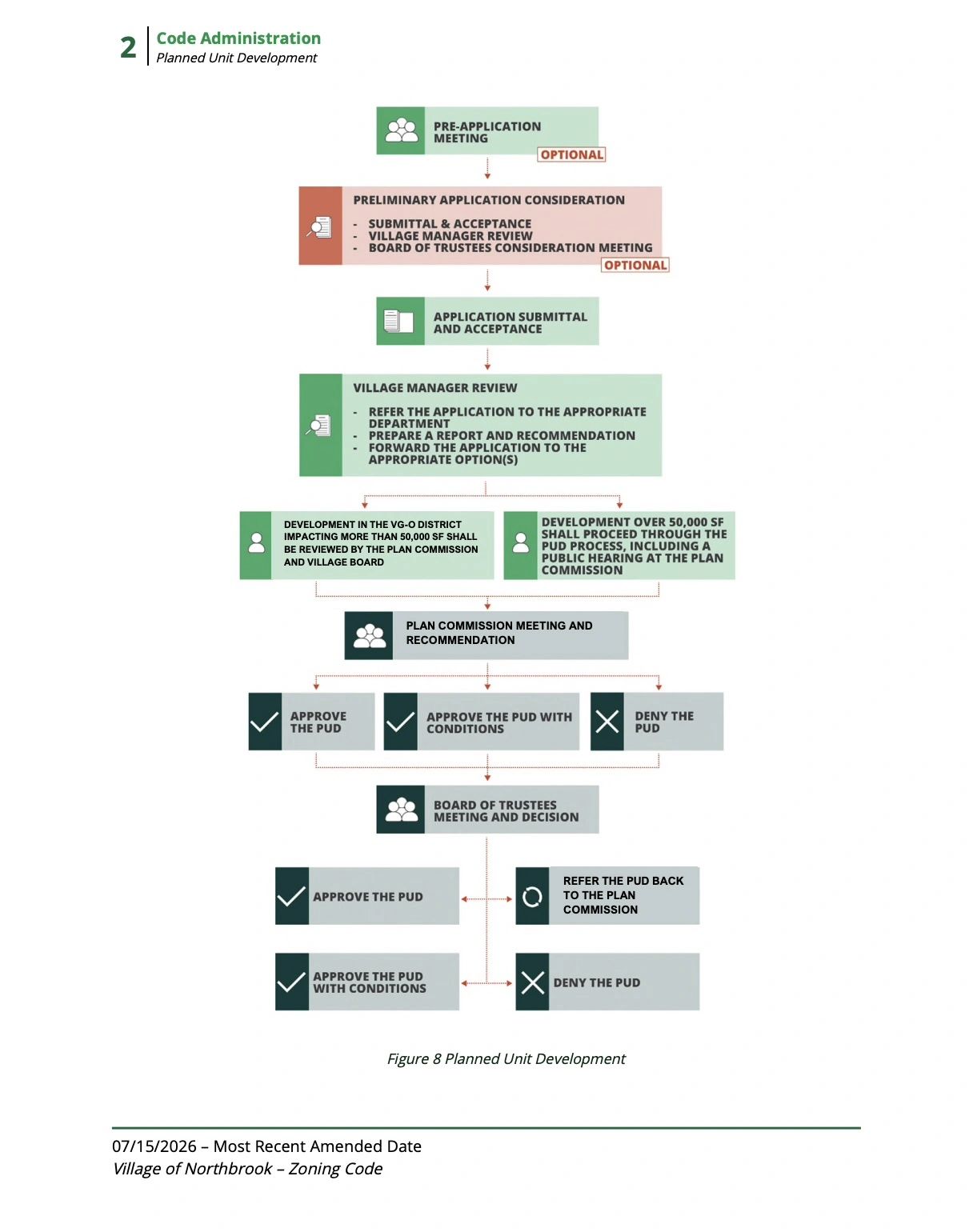
The PUD section of the zoning code itself lays out the process clearly:
“DEVELOPMENT OVER 50,000 SF SHALL PROCEED THROUGH THE PUD PROCESS, INCLUDING A PUBLIC HEARING AT THE PLAN COMMISSION.”
The next step in the flowchart is:
“PLAN COMMISSION MEETING AND RECOMMENDATION”
Why did staff recommend in May that the Board bypass a formal Plan Commission recommendation on the first major PUD under a brand-new zoning code, especially when the PUD section itself presents Plan Commission review as part of the normal process?
In fairness, the Zoning Code that they had adopted the year before is confusing about this and points in two directions.
Section 2-102.D.2, on page 13, gives the Board general authority after preliminary review to reserve an application to itself, conduct the public hearing and act without a separate recommendation from a subsidiary body.
But the provisions specifically governing PUDs say something different. Section 2-118.C.4-6, on pages 60-61, directs a development over 50,000 square feet through the PUD process, provides for Plan Commission review and recommendation, and then provides for the Board to make the final decision after receiving that recommendation. The procedures table in Section 2-103.A, page 14, shows the same sequence.
So which provision controls: the Board’s general authority to reserve “any application” to itself, or the more specific procedure the code establishes for a PUD of this size?
It’s no wonder that folks don’t understand this. It is confusing.
In any case, the Board reversed course and restored the Plan Commission step but it further highlights its own fundamental lack of understanding of the Zoning Code that had been codified one year earlier. It was refreshing to hear at least some of the trustees acknowledge that they had gotten it wrong and wanted to course correct.
But they were not quite done with that agenda item yet.
During the discussion, Ross had asked:
“If we end up sending this to the Plan Commission, typically we provide our initial thoughts and recommendations to the Plan Commission. Will we have the opportunity to do that tonight?”
Ciesla answered:
“Yes. We should do that.”
And they did.
Trustees began to go through their concerns one by one, until it was Matt Cassidy’s turn to speak.
“I’m very frustrated by what’s going on right now at the moment. We just took a vote to reverse our own decision from May, and I think one of the reasons that happened is that in May we had taken an action to do a preliminary review, which was well documented in the agenda, and we had a chance to review ahead of time, and then added a vote right after that, which wasn’t originally in the agenda, and therefore we didn’t have a chance to prepare for it. Therefore, there was a misunderstanding amongst the Board where we had different ideas of what was going on.”
He then pointed out that the Board was about to repeat essentially the same mistake.
“Now, just now, we took the vote to reverse that and immediately are adding what we’re doing right now, which is something which was also not on the agenda. I don’t have a full set of notes in front of me to give to the Planning Commission to give them direction. I didn’t know we were going to be sending them notes. So, I can’t sit here and give the Planning Commission direction when we weren’t prepared to do that.”
Cassidy made clear that he was not objecting to the substance of the other trustees’ comments.
“Some people, it’s great that they have notes. And by the way, in listening to them, I agree with a lot of the points that are being made. My frustration is not with that at all. But we’re in a position here where I don’t think every trustee here was ready to make those notes to send direction to the Planning Commission.”
He continued:
“Right now, I don’t have a complete set and I would like to have that complete set. I was not prepared to do that and I think we need to be careful about how we do that with these agenda setups and when we add something at the last minute.”
Village Manager Cara Pavlicek agreed that the additional commentary had not been part of the planned agenda item.
“This was prepared only to have a motion to reverse the earlier action. Staff did not intend that we were taking additional commentary.”
Pavlicek recommended putting the issue on the September 8 agenda, along with the minutes from the May preliminary review, so trustees could supplement or modify their earlier comments with public notice.
Cassidy also wanted more information before giving the Plan Commission direction.
“I would think that we would want the complete application packet before we did that.”
Staff explained that the application was still under review and incomplete. Cassidy clarified that he was not asking to conduct the hearing early. He wanted enough information to give the Plan Commission useful direction.
As the discussion continued, he returned to his original point:
“All I was trying to illustrate was then after the vote, we should have been done with this.”
Reese also said she was not prepared to give complete direction that night and wanted more time to understand what properly belonged before the Plan Commission.
The Board agreed to put the supplemental comments on the September 8 agenda.
8 - September 8
President Ciesla and Trustee Ebhomielen were absent. Israel again served as President Pro Tem.
The Board had put Meadow Plaza back on the agenda for one purpose: to give trustees a properly noticed opportunity to supplement the comments they had made during the May 26 preliminary review before the application went to the Plan Commission.
McEwan first walked through the review process again. Pulte was still in technical review. Staff and outside reviewers were examining traffic, stormwater, environmental material and other submissions for compliance with Village codes and development standards.
When that work was far enough along, the Plan Commission would hold the public hearing, review the requested zoning relief, compare the proposal with the Comprehensive Plan and other relevant Village plans, consider the PUD standards and make a recommendation to the Board.
Hebl said her May comments stood.
She remained supportive of moving the proposal through the process and said she looked forward to seeing what ultimately came back.
“My comments from May stand. And I look forward to the Plan Commission’s evaluation of this project. And I look forward to being, as I’ve told Amy, wowed by whatever comes before us.”
Israel returned to the commercial component.
“I value the Riverwalk and retail commercial opportunities provided by first floor retail and dining.”
But he wanted Pulte’s PUD application to contain an actual commercial plan.
“Planned unit development submittal needs to be submitted as a single submittal with the retail commercial component fully expressed and developed.”
He put it more plainly:
“This is not a player to be named at a later date situation.”
Israel also remained unconvinced by the scale of the reduction in commercial space.
“I’d like for the Plan Commission to help and staff to provide justification for what is the reduction in retail and commercial, as I remain unconvinced that a reduction from 90,000 to 11,000 square foot is warranted or right number in this case.”
Ross was even more explicit that her thinking had changed since May.
“My comments were a little different than the preliminary review.”
She wanted the Plan Commission to understand something that had been unclear during that first meeting.
“This is zoned commercial and a developer could not come in as a matter of right and just build residential. I think that’s really important.”
She thought the amount of commercial space Pulte was proposing was barely sufficient even to satisfy the purpose of the district.
“From the preliminary plans, they are proposing some commercial, but I think it’s barely meeting the intent of the code.”
Ross had spent part of the summer looking at other developments around the suburbs. She had seen vacant retail, but she had also seen commercial uses working beneath residential buildings.
She asked the Plan Commission to look again at the 2012 Downtown Plan, particularly its more open layout and its preservation of the building containing Bean Bar.
“It feels, I know we haven’t seen everything, but just on the preliminary drawings, it feels very boxed off to me, whereas the downtown plan felt much more open.”
She also raised height and density and emphasized the leverage created by the PUD process.
“This is a planned unit development. And I think the Board years ago put this into effect for these larger properties for the sole purpose of providing us with leverage to make sure we can be creative and innovative and end up with something that is best for the community.”
Cassidy had waited two weeks to give the comments he had declined to improvise on August 25.
He began by making clear that he did not want the Board to tell the Plan Commission what conclusion to reach.
“I want to make sure, because this is being referred to the Planning Commission, that we’re giving them the air they need to make the decision the way that they want to make that decision. They’re good at doing exactly this. It’s one of the reasons we referred it out.”
He shared the concerns others had raised about the balance between residential and commercial uses, but wanted the Commission to concentrate on something more fundamental than the individual deviations.
“They’re going to be looking at the variances anyway. They’re going to be looking at the height and the individual details and the context and the traffic study and all those individual pieces, because that’s their job.”
His first concern was the underlying purpose of the zoning districts.
“As a planned unit development, while that provides the Village a lot of flexibility, there are certain things it can’t flex on. One of those is the intent and description at the high level of those zoning areas, the C-2 commercial and the VGO.”
Cassidy appreciated the flexibility the PUD gave the Board and viewed it as potentially useful when a good project does not fit neatly within every dimensional rule.
But he drew a line between flexibility and abandoning the purpose of the district.
“We want to make sure that we understand that that PUD approval cannot simply say if this is the intent of a given zoning area that you can run something that is just counter to that.”
He wanted the Plan Commission to look beyond height and setbacks.
“Take a look at the intent and the description and how this presentation fits into that.”
And he specifically raised the first-floor parking beneath Pulte’s residential buildings.
“The proposal as we have it right now has parking on the first floor. Does that fit? The code doesn’t really specify what has to be on the first floor. It does say what can’t be. So again, you lean back on that intent. What is the intent of this district?”
That was a very different discussion from May.
In May, much of the Board’s attention had been on whether Northbrook needed more downtown residents, the Riverwalk, stormwater improvements and helping displaced businesses find new locations.
By September, trustees were asking whether Pulte had enough commercial development, whether its commercial plan was real, whether the site plan reflected the Village’s previous downtown planning, whether the proposed density and height were appropriate, and whether the project was consistent with the underlying purpose of C-2 and the Village Green Overlay even if individual deviations could be approved through a PUD.
Reese added concerns about Pulte’s construction quality, infrastructure, the church easement and whether the proposed open space would actually function as a public amenity connected to the rest of downtown.
She also questioned the commercial balance.
“We have been told that the market will not allow for 100% commercial. We’ve been told that over and over and over again. And I think we do understand that.”
But:
“I hope that when we’re looking at this, we can think of the underlying intent of a multi-use space for commercial and residential. And currently, what I see is a very low percentage.”
The trustees were not speaking with one voice. Hebl remained comfortable with what she had said in May. Israel, Ross, Cassidy and Reese were pressing harder on different parts of the proposal.
But the questions before the Plan Commission were considerably different from the ones that had dominated the preliminary review three and a half months earlier.
9 - September 22
Meadow Plaza was not on the agenda.
Residents nevertheless continued to speak about it during public comment. By this point, much of the discussion had shifted from the merits of the preliminary concept to the approaching Plan Commission hearing and whether residents would have enough time and information to participate meaningfully.
Several speakers pressed the Board to slow the process down. Others focused on Pulte’s record, the existing Meadow Plaza businesses, the amount of commercial space in the proposal and whether the project complied with the Comprehensive Plan, the Village Green Overlay and the PUD standards.
One speaker objected that the public would receive the Plan Commission packet only a few days before the October 6 hearing and argued that residents were being asked to evaluate months of work by Pulte and Village staff on an abbreviated timetable.
By the end of the evening, the Village had announced that the hearing materials would be released September 25, earlier than the date residents had previously understood, and that informational meetings would be held September 28 and 29.
There was no substantive Board discussion of the application that night.
Conclusion
I began this piece by saying that there appears to be a widespread belief that the Village Board wants this project and has already made up its mind.
At times, the distrust has gotten a little ridiculous.
Someone recently posted on Facebook that the coffee shop in the Metra station was closing because the Village had raised its rent to an amount the business could no longer afford. Commenters quickly moved to greed, payoffs and insiders benefiting from the decision. The rent was $400 a month before Covid. The Village cut it to $275 to help the tenant stay in business. The new rent is $300, still $100 below where it started. On a 232-square-foot space, that is $3,600 a year in total rent.
Over the weekend, a trustee who has been making a legitimate effort to be more visible and increase engagement in the community shared the Village’s post announcing that tonight’s Plan Commission hearing would be livestreamed. A resident criticized him for creating more “noise” by amplifying the Village’s own post and trying to get the word out more broadly.
We may not agree with decisions the Board has made. We may wish trustees focused on different priorities, held staff accountable for outcomes, or even held each other more accountable. Reasonable people can disagree about all of that. But these are quasi-volunteers who contribute significant time and energy to our village, and they are our neighbors.
While it is encouraging to see more residents paying attention, we should also be honest about how we got here. If more people had been engaged productively over the years, volunteering, voting, attending meetings and helping shape the direction of the Village, we might not be trying to sort all of this out in the middle of a major development application.
The process around Meadow Plaza has not inspired confidence. The process by which the new zoning code was adopted had real problems. Economic revitalization, particularly downtown, was deprioritized for years to the point that much of the Village’s commitment to it amounted to lip service.
Residents need to be part of fixing that. We need to educate ourselves, show up, ask better questions and help shape the outcomes.
But we should not confuse years of disengagement with a right to assume the worst motives once we finally start paying attention.
After going back through the meetings and the record, I think there is a much simpler explanation for how we got here.
We did not do the work necessary to prepare for a proposal like this.
Trustees received the preliminary application only four days before the May 26 meeting.
Staff did not begin by laying out the framework the Board would ultimately have to use to evaluate the project: the mandatory PUD process, the requested deviations from the underlying zoning, a reminder of what the underlying zoning actually allowed, and finally the proposal itself.
Instead, staff immediately went through the specifics of the proposal. One of the questions posed at the end of the presentation asked whether a PUD was appropriate for the site, even though the zoning code already required one for a project of this size.
Staff also recommended that the Board conduct the public hearing itself rather than send the application through the Plan Commission, even though the PUD framework contemplated Plan Commission review and a recommendation before the Board acted.
Over the course of three meetings, the Village President then repeatedly misstated what could be built on the property without Board approval.
None of that looks like a well-orchestrated effort by Trustees to ram through a predetermined outcome.
It looks like a bad process, weak guidance, a lack of understanding of the zoning code the Board itself had recently adopted and trustees trying to get their arms around the first major PUD under the new rules.
And over the months that followed, something changed.
The trustees started pushing back.
They questioned the commercial component. They revisited the Village Green Overlay. Several acknowledged that their understanding had changed. The Board reversed its earlier decision to bypass the Plan Commission. Trustees began asking what Pulte actually had to demonstrate under the PUD standards rather than simply reacting to the broad concept of adding more housing downtown.
If anything, I see some trustees starting to come alive and beginning to exert their own responsibility and, in several cases, swimming against the current.