This is the fourth installment in my series on Northbrook’s local politics. A common question I hear is: Why am I doing this? What does success look like?
As the saying goes: “The journey of a thousand miles begins with one step.”
To me, success means more engagement, more participation, and a greater understanding of how decisions are made in our community. Right now, frustration runs high, but active involvement remains low. At the same time, there appear to be few organized efforts to improve engagement.
One of the clearest signs of this disengagement is voter turnout. In the past 15 years, our highest participation in a local election was just 24.7% in 2021. More often, it lingers in the single digits. Complicating matters further, outside political groups have weighed in on our elections—though their priorities don’t seem to align with increasing voter engagement. Local institutions like the Northbrook Caucus, which may have started with good intentions, have become a mechanism for maintaining the status quo.
From my observations, those who express an opinion on Northbrook’s governance often fall into two camps: those who believe the Village Board is doing an exceptional job, and those who believe it is failing miserably. I believe that disagreement tends to be the result of lack of common understanding – if we disagree, one of us likely knows something that the other does not.
To bridge this gap, I recall what a CFO (who I worked with eons ago) explained as the secret of happiness in a simple formula: H = A / E. In this equation, H represents Happiness, A is Actual Experience, and E is Expected Experience. I’d add a caveat—the equation only works if A and E aren’t artificially manipulated to impact the outcome.
Before we can evaluate how the current board is doing (my best attempt at determining A in that equation), we need to take a hard look at what E—Expected Experience—should actually be. And on that front, I can say emphatically: many in the village have inflated expectations of what the board can actually do. At the same time, this board’s level of transparency and community outreach is objectively poor.
For reference, there’s a wealth of publicly available information on the Northbrook Village website (though, frustratingly, the categorization of documents leaves something to be desired). The FY25 budget, which governs village spending from May 1, 2024, through April 30, 2025, is a 371-page document full of valuable insights. You can find it here: https://www.northbrook.il.us/.../7816/FY-2025-Adopted-Budget
Northbrook is a home rule municipality under the Illinois Constitution and operates under the Council/Manager form of government, as established by Article 5 of the Illinois Municipal Code (65 ILCS 5/5-1-1).
The Council/Manager system is a structure designed to balance professional administration with elected oversight. In this system:
- The Village Board (Council) serves as the legislative and policy-making body, setting goals, enacting ordinances, and approving budgets.
- The Village Manager, a professional administrator, implements policies, oversees daily operations, and manages municipal staff.
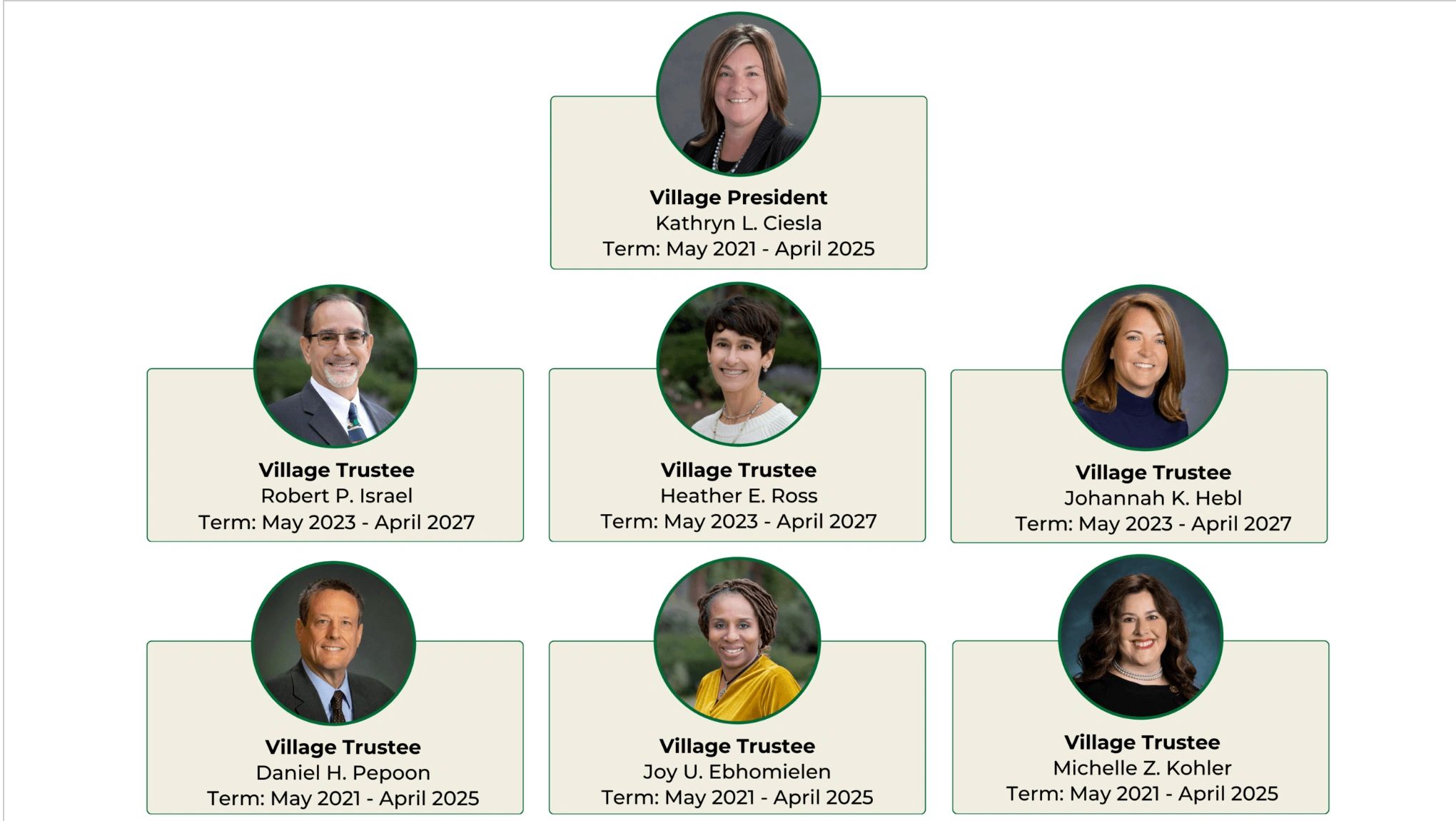
In Northbrook, the Village Board is comprised of six elected Trustees and a Village President, who serves a four-year term as the chief elected official. The President presides over Board meetings, executes official documents, and appoints committee and commission members with Board approval. The Board of Trustees consists of six members, each elected at large to four-year staggered terms.
Village Trustees and the President serve in a part-time capacity, receiving modest stipends: $5,800 annually for trustees and $6,400 for the president, totaling $41,200 plus a small training budget. For perspective, that’s approximately $1.20 per resident annually—covering all Village Board members combined.
While policy decisions rest with the Board, the execution of those policies is handled by the Village Manager, who acts as the Chief Operating Officer of Northbrook. The Manager is appointed by the President and Board of Trustees and serves at their pleasure. The Village Department heads report to the Village Manager.
The Village Manager receives a base salary of $275,000 per year, excluding additional benefits and performance-based incentives outlined in the employment agreement. In September of 2024, the board approved a $23,000 increase in the Village Manager’s base compensation (9.1%) and a $30,000 bonus payable in equal increments across the next 24 pay periods.
All of this was done for doing an “outstanding” job in her first three years when comparing the Village Manager's responsibilities, achievements, and compensation to other village managers in the area. Read more here: https://www.chicagotribune.com/.../northbrook-gives.../
While current rankings are unavailable, historical data indicates that Northbrook has consistently compensated its Village Manager at the upper end of the state’s pay scale.
- A 2012 Patch article (https://patch.com/.../study-northbrook-village-manager-is...) reported that Northbrook’s Village Manager was the 4th highest-paid in Illinois, earning $236,689 in total compensation.
- A 2016 Patch article (https://patch.com/.../grayslakes-michael-ellis-among...) stated that Northbrook had moved up to the 2nd highest-paid in Illinois, with the Village Manager’s total compensation rising to $263,392.
** Please note - the figures presented compare the Village Manager’s base compensation and bonus against prior reports of total compensation, meaning the numbers are not directly equivalent.
I think it is reasonable to conclude that Northbrook is willing to pay at the top of the market for our Village Manager and we should reasonably expect to attract the best and brightest to this role, relative to the available talent.
I've included a graphical representation of Northbrook’s village government org chart
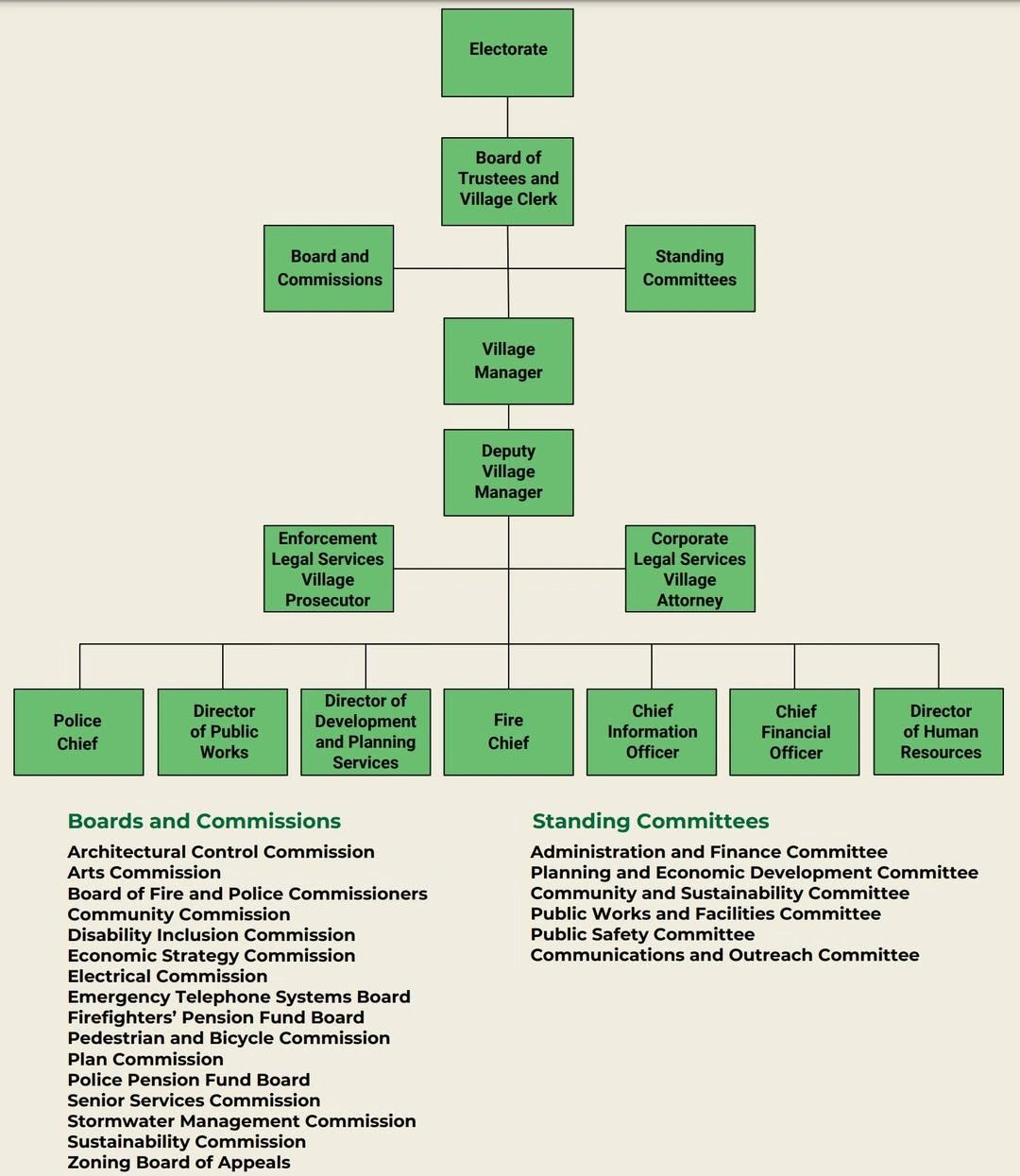
This form of government is meant to separate political leadership (vision and policy-setting) from professional management (execution and operations). The goal is stability and efficiency—ensuring that administrative tasks are handled by professionals rather than politicians. However, because the Village Manager serves at the pleasure of the Board, it is fair to hold trustees accountable not only for their vision and policy decisions but also for how effectively they oversee and evaluate the Village Manager’s performance.
The core functions of local government include ensuring effective delivery of public safety, infrastructure, water and sewer services, zoning and development oversight, and financial stability.
It also seems fair to evaluate the board in terms of how effectively they activate the community, ensuring not only that every resident’s voice is sought after and considered, but that standing committees and boards & commissions never have open positions. This includes being transparent with residents about their goals, plans, and progress. I will delve into this in future posts.
It’s important to recognize both the opportunities and limits of village government in economic development. While Northbrook can foster a business-friendly environment, broader economic forces—such as market demand, state policies, and regional investment—play a significant role in development. Large-scale projects require coordination with county and state agencies, as well as private investors, making direct village-driven expansion complex.
Northbrook’s downtown faces unique challenges compared to neighboring communities—while we have a Metra station, every passing train (Metra, Amtrak, or freight) stops our main artery of Shermer Ave, snarling traffic along Walters, Cedar, Cherry, and Meadow. Additionally, before and after school traffic brings Northbrook to a standstill. And, though beautiful and a great asset to downtown, the Village Green park occupies a huge portion of the downtown but offers no commercial value. Lack of housing density likely restricts the willingness of businesses to develop downtown. Northbrook’s commercial areas are spread across Dundee, Skokie Blvd, Lake Cook, and Willow Road, making it less cohesive.
This is not to say that the task is impossible by any means – and should not be used as an excuse by any board; after all, we elect them for what they can do, not simply to tell us why something is hard or not their fault.
So, in the end, what should our Expected Experience (E) of the Village Board be? Holding them to a high standard is not just fair—it’s necessary. However, that standard must also be grounded in what is realistically within their control. While Trustees cannot control macroeconomic forces, they are responsible for setting a strategic vision, prioritizing financial stability, mitigating risks, and ensuring policies align with community needs.
In the coming posts, I will analyze the Village Board’s progress over the past four years—comparing their stated objectives with actual outcomes. This will provide a clearer picture of where they’ve succeeded and where challenges remain. While assessing the Village Board’s performance is an imperfect science, neither the Caucus nor Northbrook Focused have provided a comprehensive, data-driven evaluation of how this board has actually performed. I will attempt to supplement that gap and would welcome others to contribute.