A lot has happened at Village Hall in Northbrook since my last post.
The Village Manager announced her plans, after five years at the helm in Northbrook, to retire at the end of September. The Police Chief announced his retirement and will be succeeded by a longtime Northbrook police veteran and Glenbrook North graduate. The Village adopted its first-ever Strategic Plan and a new Communications Plan (along with the not-yet-formally-announced hiring of a Communications Director). Poupard Place opened, adding 48 units to Northbrook's affordable housing stock. The Village agreed to purchase Red's Garden Center for the future police station, and we finally appear poised to sell the remaining Grainger property to a developer who intends to build luxury condos.
Each of these deserves discussion—and several probably deserve posts of their own. But one issue has drowned out almost every other conversation in Northbrook: the proposal to redevelop Meadow Plaza.
I've read the preliminary proposal, transcribed all three Village Board meetings where it has been discussed, reviewed the impressive grassroots petition opposing it, and gone back through years of Village planning documents.
There is a lot to unpack, but one conclusion kept coming back to me:
This was a completely foreseeable moment, and Village Leadership appears remarkably unprepared for it.
One word of warning before diving in: this is another materially long post. Here's the short version, if you don't have time for the rest.
Pulte put forth a preliminary proposal for the Village Board to react to, one that significantly reduces the amount of retail space at Meadow Plaza and increases residential density. A small group of residents started a grassroots petition that now has massive support, to stop the development, and have successfully filled a void in the narrative that our Village leadership is either unwilling or incapable of filling. So instead of a broad conversation about the future of Northbrook, and how this proposal fits into a broader downtown vision the Village has had in some form for fourteen years, there is a serious effort to save a shopping center, beloved as it is, that has not been materially improved in 30 years, operates on short-term leases at below-market rents, and evidently generates less than $200,000 in annual sales tax for the Village. I have serious questions about how well our existing downtown businesses are actually doing today, questions this debate has barely touched. My bet, however, is that they would welcome a tranche of new consumers near their businesses. I worry less about an imperfect proposal getting approved, and more that our track record of making life difficult for developers will persist, and we end up with empty space for years to come. And, if we cannot materially expand our sales tax base, then the nearly $100 million in public infrastructure and $100 million more in pension obligations will be paid by higher property tax levies or reduced services.
For those of you who want to proceed, here is the structure of the piece.
Part I – Background
Background on Meadow Plaza, the Stop Pulte Homes' 6-story condo development at Meadow Plaza petition, and the public commentary from three Village Board meetings.
Part II – My Thoughts
My perspective, followed by a point-by-point assessment of the petition's claims on schools, traffic, character, flooding, retail, and infrastructure, and a few final observations about the petition itself.
Part III – Three Questions
Three broader questions I don't think the debate has adequately addressed: whether we actually know how downtown as a whole is performing, what happens if nothing gets built at all, and what problem we're actually trying to solve.
Part IV – Conclusion
The very real risk that we not only lose the beloved Meadow Plaza, but never build the downtown we need.
One note before proceeding
As I was preparing to publish this, a ten-page summary of documents obtained through a Freedom of Information Act request began circulating online. The summary shows that Village staff and elected officials were more directly involved with the Meadow Plaza owners and prospective developers than the Village's recent public messaging might suggest. Among other things, they discussed residential redevelopment and affordable-housing requirements with ownership in summer of 2024; the initial parameters conveyed by the Village appear to have steered the owners back toward retaining the property as a retail center ("After reviewing [Northbrook's parameters for redevelopment]... with a couple lenders and developers... my team communicated back to [Deputy Director of Development] the redevelopment was financially impossible and we are focused on leasing the center."); and the Village President then encouraged a more creative redevelopment discussion and made clear that the Board wanted something new on the site.
I have not materially changed the piece that follows because these records do not change my central argument. If anything, they reinforce it. The problem is not that Village leadership was involved early on - they should be, though it is strange that their public posture seems to suggest otherwise. The problem is that, despite repeated promises about revitalizing downtown, the Village has failed to deliver on nearly every one of them, and never developed a public vision, pursued meaningful community engagement, or established a clear framework for evaluating the redevelopment before it became public.
That failure of communication and leadership is a major reason we find ourselves in a position where this re-development appears to be deeply unpopular with Northbrook residents.
Meadow Plaza
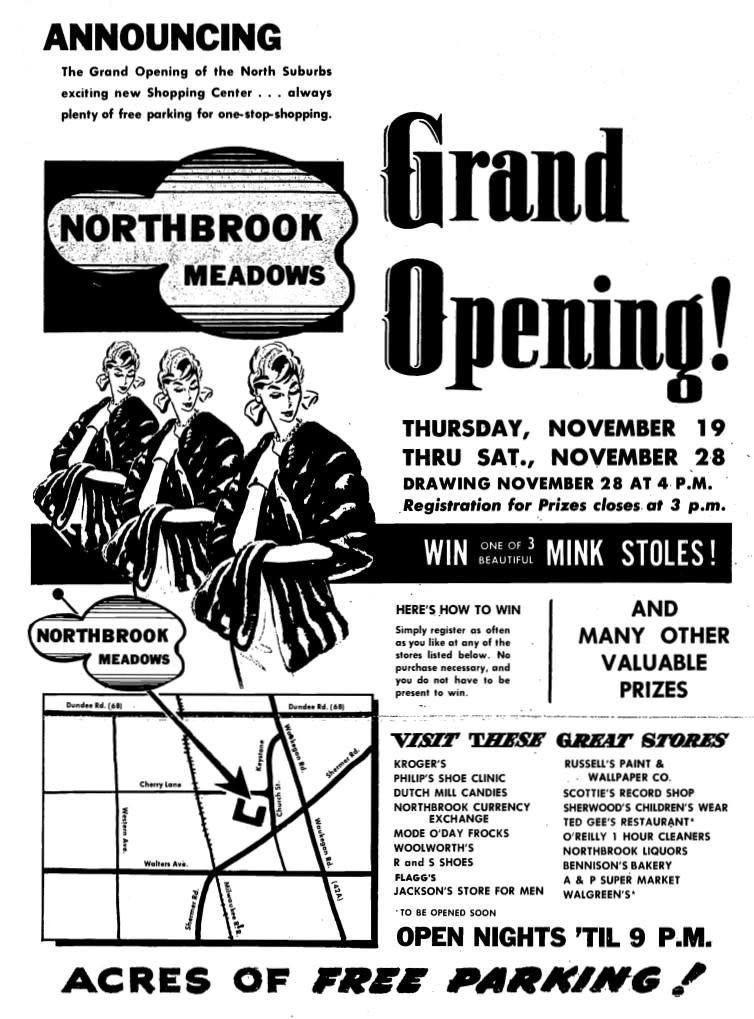
Meadow Plaza is a 6.94-acre shopping center at the corner of Cherry Lane and Meadow Road, owned by the Heitman family for decades. It opened in November 1959 as Northbrook Meadows Shopping Plaza, with anchors including Kroger, A&P, Woolworth's and Walgreens. Kroger quickly gave way to Sunset Foods, which later relocated across the street to its current location. Walgreens relocated in 2010, while continuing to pay their lease and leaving little reason to fill the resulting empty storefront. It remained vacant for years before eventually becoming the auto parts store that remains there today. Marcello's served generations of Northbrook families before closing a few years ago, while more recent additions have included Moksha Indian Bistro, Book Bin and Bean Bar. The last major renovation of the shopping center occurred in 1993. Since then, improvements have largely been limited to tenant build-outs and routine property maintenance. The shoe repair shop and dry cleaner remain the only original businesses still operating in the center, albeit under different ownership.
Based on a comment by a Village Trustee during the July 14 meeting—which I am treating as accurate, though I have no independent means of verifying it—the shopping center generates approximately $197,000 annually in direct Village sales tax revenue. At the Village's 2% local sales tax rate, that equates to roughly $9.9 million in annual taxable retail sales, or approximately $110 in sales per square foot across the center's roughly 90,000 square feet. This is an imperfect proxy because not all tenants or transactions generate taxable retail sales, but it nevertheless suggests the center is not a particularly productive sales-tax asset. By comparison, the average U.S. retailer generates approximately $325 in annual sales per square foot, with retailers below $250 per square foot generally considered weak performers. All of downtown generates less than $1.5 million annually in Village sales tax revenue, ranking a distant sixth among Northbrook's commercial districts and ahead of only Sanders Court.
The property has been on and off the market for years. It was reportedly under contract before the COVID-19 pandemic, but the sale never closed. Over that time, the property has largely operated on short-term tenant leases at below-market rents, an arrangement that gave the owner flexibility to sell but did little to encourage reinvestment in the center. The property was actively marketed for sale again beginning in 2024 and culminated with Pulte Home Company emerging as the successful purchaser after the family reportedly received more than fifteen offers, nearly all of them residential. It is not clear how they were able to attract new tenants while actively marketing the property.
Pulte's preliminary proposal, presented to the Village Board for non-binding feedback on May 26, would demolish the existing Meadow Plaza shopping center and construct three six-story condominium buildings containing 150 for-sale units, structured parking integrated into the buildings, two commercial parcels, and associated site improvements. Because the proposal exceeds the property's existing zoning, it would require subdivision of the property, a Planned Unit Development (PUD), rezoning of a small portion of the site, and relief from the current four-story height limit. This is what prompted Pulte to appear before the Village Board for non-binding early feedback.
The Petition
Shortly after Pulte presented its preliminary proposal to the Village Board, a Northbrook resident created a Change.org petition with the self-explanatory title, "Stop Pulte Homes' 6-story condo development at Meadow Plaza." The petition had surpassed 3,700 signatures as of this writing. By any measure, and certainly by Northbrook standards, it represents an extraordinary level of civic engagement around a local land-use decision. For perspective, only 8,576 ballots were cast in Northbrook's April 2025 municipal election, representing roughly 30% of the Village's 28,271 registered voters.
The petition asks the Village Board to provide negative feedback on Pulte's preliminary proposal and ultimately deny the requested rezoning, subdivision, Planned Unit Development (PUD), Village Green Overlay approvals, height relief, and related amendments that would be required for the project to move forward. It argues that the proposal would increase traffic congestion and pedestrian safety concerns, place additional enrollment pressure on Northbrook School District 28 and potentially Glenbrook High School District 225, alter the scale and character of the surrounding neighborhood, increase flooding and stormwater risks, reduce neighborhood-serving commercial space, and place additional demands on public infrastructure and Village services.
Beyond opposing the current proposal, the petition asks the Village to require any future redevelopment to remain within the existing four-story zoning limit, maintain commercial viability, and fully address traffic, flooding, school capacity, and neighborhood compatibility before moving forward.
Taken together, the petition characterizes the proposal as overdevelopment that prioritizes developer profits over residents and urges the Village to protect what it views as the character and quality of life that have long defined Northbrook.
The Public Response
This proposal has been a recurring topic—both as an agenda item and during general public comment—across three recent Village Board meetings: May 26 (when the preliminary review was conducted), June 23, and July 14. The petition's organizer galvanized residents to come speak directly to the Board, and the tone of those meetings shifted noticeably over time. The May 26 preliminary review was largely measured, with residents asking clarifying questions about zoning, process, and the future of specific Meadow Plaza businesses. By June 23, opposition had sharpened, with direct comparisons to the Grainger redevelopment and pointed questions about whether public input meaningfully influences outcomes. By July 14, the issue had become one of the largest public discussions the Village has seen in years, with roughly 400 people attending, many wearing matching yellow "Save Downtown Northbrook" T-shirts. The petition had clearly done more than collect signatures online. It had organized people, and organized them well.
At both the June 23 and July 14 meetings, the Village President opened public comment by acknowledging the emotional attachment many residents have to Meadow Plaza and the businesses it houses, while also noting that the property has been for sale for years, requires significant investment, and presents environmental remediation challenges. She emphasized that the Village neither owns the property nor participated in its sale, that no formal development application had yet been submitted, and that any proposal requiring zoning relief would undergo a lengthy public review process with multiple opportunities for public input. She also reminded residents that the current zoning already permits a four-story, all-residential redevelopment without Village Board approval, and argued that the value of the Planned Unit Development process is the opportunity to negotiate community benefits—such as replacement retail, a riverwalk, and other public amenities—that otherwise could not be required. Finally, she discussed the Village's efforts to help existing Meadow Plaza businesses relocate within Northbrook should redevelopment ultimately occur and encouraged residents to continue supporting those businesses.
Across all three meetings, the same themes surfaced repeatedly from the public. By far the most common concern was preserving the businesses and community character that Meadow Plaza represents. Speaker after speaker described Meadow Plaza not simply as a shopping center, but as a community gathering place where people meet for coffee, buy books, repair shoes, attend the Northbrook Farmers Market, or simply run into neighbors. Many acknowledged that the property itself is aging and needs reinvestment, but distinguished between revitalizing Meadow Plaza and replacing it with a largely residential development.
Other concerns were equally consistent. Residents questioned whether Cherry Lane and Meadow Road could safely accommodate additional traffic, particularly during Greenbriar drop-off and pickup. They raised concerns about school capacity, flooding and stormwater management, the scale of the proposed buildings, and whether the project fit the character of downtown Northbrook. Many argued that redevelopment efforts should instead focus on sites such as Northbrook Court, Greenacres, Grainger, or other underutilized properties before displacing an occupied shopping center.
There were also broader questions about the process itself. Several speakers questioned why the Village appeared to be reacting to a developer's vision rather than advancing one of its own. Others wondered how much influence public input would ultimately have and whether the community was being invited into the conversation early enough to meaningfully shape the outcome.
Among the many exchanges over those three meetings, one in particular stayed with me. After the initial 30-minute public comment period concluded during the July 14 meeting, many attendees began to leisurely file out of the room even though the meeting was not in recess and public comment would resume later that evening after the rest of the agenda had concluded. As one attendee stepped toward the dais, she asked why the Village didn't simply purchase Meadow Plaza. The Village President replied, "Well, you can buy it—because we're spending $150 million on police stations and fire stations. But I'm not going to argue with you. I just want to finish the meeting."
My Thoughts
Purchase Meadow Plaza for what purpose?
Those who spoke during public comment—and many others online—seemed to have one answer in mind: preserve Meadow Plaza largely as it exists today. Speaker after speaker described it not simply as a shopping center, but as a community gathering place where people meet for coffee, browse for books, repair shoes, attend the Farmers Market, and run into neighbors. Many acknowledged that the property itself is aging and needs reinvestment, but distinguished between revitalizing Meadow Plaza and replacing it with a largely residential development.
I understand that sentiment. My family would miss many of these businesses. We love Bean Bar. We appreciate the unbelievable service at Ace Hardware. Our eye doctor is at Rosin. We still take our shoes to the Shoe Clinic. Our boys grew up grabbing sandwiches at Subway after games, and we still wander into La De Da whenever we need to find a gift for friends.
But that doesn't justify public ownership. I don't know what Pulte ultimately agreed to pay for Meadow Plaza, but let's assume it was approximately $15 million. The Village would have needed to spend at least that much, and likely more, to outbid the large number of interested buyers. That is nearly twice what the Village spent to acquire the Grainger property. In return, it would own a shopping center that has not undergone a major renovation since 1993, generates relatively little Village sales tax revenue, and has been intentionally positioned for redevelopment for years. The Board's responsibility is to make fiduciary decisions on behalf of all 35,000 residents, not simply preserve places many of us understandably cherish. Acquiring Meadow Plaza simply to maintain the status quo would not represent a prudent use of public resources.
There is another rationale for acquiring a property like Meadow Plaza.
Several years ago, the Village's now-defunct Economic Strategy Commission recommended exploring whether the Village should acquire the property as a way to help shape the future of one of downtown's most important redevelopment sites. That recommendation never reached the Village Board because Village staff believed the Board was unlikely to pursue another significant land acquisition so soon after purchasing the Grainger property.
To be fair, our experience with Grainger can hardly be described as an overwhelming success. We purchased the property with the vision of relocating the Metra station and, eight years later, we have given away a portion of the property and now finally appear poised to sell the balance for luxury apartments. At least with Grainger we had a clear, albeit faulty, point of view about what we wanted to accomplish.
With Meadow Plaza, there is no comparable objective. If the Village has a vision for downtown, it is an incredibly well-kept secret.
Yes, the Caucus candidates campaigned in 2025 on downtown revitalization, including developing an updated Downtown Master Plan with the assistance of an urban planner and public input. Similarly, the Hometown redevelopment agreement included a series of specific downtown commitments, including retaining a design professional, developing Downtown Improvement Plans, engaging the community, and returning to the Board with recommendations by May 2026.
All of those commitments have gone unfulfilled.
As a result, we are left in the remarkable position of looking back nearly fourteen years to find the Village's last comprehensive public vision for downtown. I have been told that portions of the 2012 Downtown Area Plan have been amended over the years, but I have been unable to determine what those amendments were or when they were adopted. As discussed earlier, Meadow Plaza plays a prominent role in that plan.
Saying downtown revitalization is a priority is much different than demonstrating that it is a priority. The controversy surrounding Meadow Plaza was entirely predictable. The property was identified as a key part of downtown revitalization more than a decade ago, and it has been for sale for years. Yet now that we finally have a buyer and a preliminary proposal, we appear completely unprepared.
Buying Meadow Plaza would be a mistake, not because municipalities should never own strategically important property, but because we have neither the vision, the planning, nor the demonstrated ability to execute such an ambitious undertaking. To the Village President's broader point, while I believe she materially overstated the cost, Northbrook is also entering one of the most expensive periods of public infrastructure investment in its history. I will come back to that later.
With that question addressed, it's worth turning to the substantive concerns raised in the petition itself, beginning with schools.
Schools
The petition raises concerns that 150 additional condominium units will overcrowd Northbrook School District 28 and potentially Glenbrook High School District 225. On its face, that's a perfectly reasonable question. Any meaningful residential development should consider its impact on local schools.
There is good reason to believe the impact would be very manageable.
First, this product will likely be marketed primarily toward empty nesters and longtime Northbrook residents looking to downsize without leaving the community. As I noted in a May 8 piece on density and downtown revitalization, roughly 58% of Northbrook households consist of one or two people. While some younger families will undoubtedly purchase units, this is not the same demographic profile as a subdivision of detached single-family homes.
Second, condominium developments have historically generated significantly fewer school-age children than comparable numbers of detached single-family homes. That doesn't mean the impact is zero, but it does suggest that equating these 150 units with enough additional students to threaten the excellence of our local schools is a considerable stretch.
District 28 is also in the midst of a significant expansion and modernization effort following voter approval of a $94.9 million referendum in 2025, the primary funding source for the district's $115 million Build28 initiative. More importantly, district leadership has indicated that current enrollment is approximately 1,900 students in facilities with capacity for roughly 2,500.
Even in the unlikely event that enrollment greatly exceeded expectations, attendance boundary adjustments would remain one of several tools available to manage capacity before additional construction would become necessary.
Could these projections prove wrong? Absolutely. Before any final approvals are granted, I would expect District 28 to provide its own enrollment analysis and for that analysis to become part of the public record.
Based on the information available today, however, I do not find school capacity to be a persuasive argument against the proposal. It deserves continued analysis and validation by District 28, but it is not, in my opinion, an immediate disqualifier.
Traffic
The petition also raises concerns about traffic. Here, the answers are less clear.
Anyone who regularly drives through the Cherry Lane and Meadow Road corridor knows it already experiences significant congestion, particularly during District 28 school drop-off and pickup. Add in the frequent Metra trains that periodically halt traffic throughout downtown, the less frequent but far more disruptive freight trains that send motorists searching for alternate routes down Walters Avenue or First Street to Cedar Lane, and it is easy to understand why residents are concerned about introducing additional residential density into this part of town.
In my opinion, the Village has compounded some of these challenges with decisions like converting the Cherry Lane and Cedar Lane intersection into a four-way stop. Whether or not that decision was appropriate on its own, it illustrates a broader point: traffic in this area has increasingly been a challenge for years.
The Village's 2012 Downtown Master Plan recognized that traffic and circulation would become fundamental constraints on any meaningful redevelopment of Meadow Plaza. It evaluated concepts including improved street connectivity, revised access points, pedestrian enhancements, and intersection improvements to support a denser downtown.
I'm simply not clear how many—if any—of those recommendations were ultimately implemented in obvious anticipation of the eventual redevelopment of Meadow Plaza. I have not been able to find any meaningful update to the 2012 study or a similarly comprehensive transportation strategy since then. That strikes me as remarkable for a Board that has consistently identified downtown revitalization and increased residential density as priorities in an area that is clearly not naturally equipped to accommodate them. These are questions that should have been answered—and re-answered—years before Pulte ever submitted a preliminary proposal.
Unlike the school capacity concerns, I do not think this issue can be resolved with broad assumptions. The interaction between Cherry Lane, Meadow Road, Cedar Lane, Shermer Road, the railroad crossings, school traffic, pedestrians, bicycles, buses, and downtown parking is simply too complicated to wave away. It is further complicated by the reality that Meadow Plaza would likely represent only the leading edge of a broader wave of downtown redevelopment. If the Village succeeds in bringing more residents downtown, that additional foot traffic should make surrounding properties more attractive for both new businesses and future redevelopment. In other words, the transportation solution cannot be designed solely around Meadow Plaza. It has to anticipate the downtown the Village says it wants to create.
I have no doubt the Village will require Pulte to commission an independent traffic study as part of any formal application, and it absolutely should. However, after more than a decade of identifying Meadow Plaza as a key redevelopment opportunity—and after repeatedly campaigning on downtown revitalization and increased residential density—for the Village to not already have a current transportation strategy is stunningly negligent. Instead, we are reacting tactically to a proposal that advances explicit campaign promises without first demonstrating a clear understanding of how those promises could realistically be achieved.
Overdevelopment and Neighborhood Character
The petition argues that replacing Meadow Plaza with six-story residential buildings would fundamentally change the scale and character of this part of downtown. It also argues that the buildings would "tower over" nearby properties and establish a dangerous precedent for future redevelopment.
Unlike schools or traffic, there is no objectively correct answer here. Reasonable people can disagree about whether six stories is appropriate for this location. Ultimately, this is a matter of judgment and, to some extent, personal preference.
The first question is physical scale. A six-story building naturally gives people pause, but describing the proposal as "towering over" the surrounding area overstates the case. The proposed buildings are approximately 68 feet tall. For comparison, the office building at 1200 Shermer is approximately 67 feet tall. The office building at 1240 Meadow is five stories and approximately 54 feet tall, not including rooftop mechanical equipment that materially increases its apparent height. The Citadel immediately south of the Metra parking lot is also five stories. The proposal would become the tallest building in downtown Northbrook, but only marginally taller than buildings that already exist.
The second question is neighborhood character, and that is even more subjective. More importantly, the relevant comparison is not between today's Meadow Plaza and a six-story redevelopment. Meadow Plaza has been openly marketed for years and redevelopment in some form appears inevitable. The more meaningful question is whether the difference between four stories and six stories materially changes the character of downtown Northbrook, not just at this site, but as part of the broader downtown the Village says it wants to create.
Character also means different things to different people. If the character residents are trying to preserve is the collection of long-standing local businesses, that is an entirely understandable objective, even if preserving the shopping center itself is unlikely to accomplish it over the long term. If the character being preserved is the physical shopping center itself, that argument is less persuasive. Meadow Plaza has not undergone a meaningful renovation in more than thirty years, portions of it have sat vacant for extended periods, and the property has been actively marketed for redevelopment for years. It is difficult to conclude that preserving an aging shopping center in largely its current form is synonymous with preserving the character of downtown Northbrook.
All that said, this is an entirely reasonable point because it aligns with the Village's own recently updated zoning code. The Village retained a four-story maximum in this area. Whether that reflects the Board's ultimate vision for downtown or simply establishes a starting point for future negotiations, it suggests the Village itself sees a meaningful distinction between four and six stories.
Approving a six-story building at Meadow Plaza would not automatically unleash a wave of six-story (or more) redevelopment across Northbrook. Every redevelopment proposal will continue to be evaluated on its own merits. The concern about precedent is understandable, but it also highlights why the Village should have developed—and, more importantly, socialized—a comprehensive vision for downtown long before a specific proposal arrived. Without that framework, residents are left evaluating this project against today's downtown rather than the downtown the Village Board has spent years saying it wants to create.
A current Downtown Master Plan could establish where additional height is appropriate, where it is not, how redevelopment sites relate to one another, and what the Village ultimately wants downtown to become. Instead, each proposal risks becoming its own referendum on density because the larger vision remains either unfinished or, at a minimum, poorly communicated.
Flooding and Stormwater
The petition raises concerns that redeveloping Meadow Plaza will worsen flooding because of its location within the floodplain and the addition of buildings, parking, and other impervious surfaces.
It is hard to fathom why this point was included in the petition.
The existing Meadow Plaza is already almost entirely impervious, consisting primarily of buildings, asphalt parking lots, drive aisles, and sidewalks. Built in 1959, decades before modern stormwater codes existed, it is difficult to imagine the site provides any meaningful onsite stormwater detention. The proposed redevelopment would replace a substantial portion of that pavement with approximately 4.3 acres of naturalized stormwater detention serving both the residential and commercial portions of the development.
Based on the preliminary plans, this appears to be one area where the redevelopment would both materially and objectively improve existing conditions.
Loss of Retail
The petition also raises a very reasonable concern about the loss of retail. For years, the Village has said it wants a more vibrant downtown with additional restaurants, shopping, and places for residents to gather. Yet the first major redevelopment proposal moves in precisely the opposite direction.
Today's Meadow Plaza provides approximately 90,000 square feet of retail space. The preliminary application, by contrast, identifies two commercial outlots totaling approximately 1.6 acres that would ultimately be sold to a separate commercial developer. There is no identified commercial developer, no building plans, no committed retail square footage, no tenant mix, and no construction timeline. For purposes of this discussion, I'll assume the two outlots ultimately support approximately 10,000 square feet of retail. If that's even close to correct, it represents nearly a 90% reduction in retail square footage from what exists today.
At the same time, it is important to recognize that Meadow Plaza is privately owned, has been openly marketed for redevelopment for years, and is not zoned exclusively for retail. Ultimately, the market, not the Village, will determine the highest and best use of the property within the framework established by the Village's zoning code and approval process. The Village can influence that outcome, but it cannot simply decide that this property should remain a 90,000-square-foot shopping center forever if the market no longer supports that use.
The Village Board appears to recognize this concern. During the preliminary discussion, several trustees expressed interest in using the Planned Unit Development process to negotiate for additional first-floor retail as part of the redevelopment.
Out of curiosity, I asked a commercial developer to run some back-of-the-napkin math on what it would likely cost to move parking underground to make room for additional first-floor retail. The resulting estimate concluded it would add roughly $15 million in hard construction cost across the three buildings while adding back approximately 60,000 square feet of retail, well short of Meadow Plaza's current 90,000 square feet, but far more than the roughly 10,000 square feet the current plan assumes.
Spread across that added space, the incremental cost they would need to recover works out to about $250 per square foot, which does not seem unreasonable for well-located downtown retail.
So the math alone doesn't kill the idea. The bigger obstacle is Pulte's business model. It builds and sells homes; it does not hold and lease commercial space. Unless a retail investor or joint-venture partner is lined up to take that component off its hands, and it's worth noting nobody has been publicly identified for the two commercial parcels in the current plan, there is no clean exit for the additional $15 million. If the Village pushes for additional retail through the PUD process, this is likely to be Pulte's real source of resistance.
There is also a real question of whether buyers paying $800,000 for a condo want to live above ground-floor retail, with the deliveries, trash pickup, and evening foot traffic that comes with it, particularly if the tenant turns out to be a restaurant with a late close. Neither obstacle is fatal. Retail below residential works in plenty of walkable, higher-density markets. But both help explain why this is a harder sell than the construction math alone suggests.
One thing I do like about ground-floor retail: it avoids a risk that the standalone commercial pads currently proposed carry. A drive-thru quick-service restaurant is one of the last things I'd want in downtown. But having lived above a restaurant when I was younger, I also have zero interest in ever living above retail again.
Whatever the final retail configuration turns out to be, it is also worth noting that at least some existing Meadow Plaza businesses are already finding new homes, or are well on their way. Rosin Eyecare is actively building out the former Hallmark space across the street and expects to relocate there soon. Bean Bar recently announced a second location in Highland Park while continuing to pursue multiple avenues for its longer-term future in Northbrook - though I think many of us would understand if they ultimately chose to leave Northbrook permanently. The Village has also committed to helping the remaining businesses find new homes, which I suspect will prove to be more a question of comparable economics than finding available storefronts.
One final point about the loss of retail claim in the petition. This issue needs to be evaluated in the context of what downtown is becoming, not simply what it is today. While this proposal appears likely to reduce the retail footprint on this site dramatically, it also introduces hundreds of new residents within walking distance of the downtown core. Those residents become customers, not just for whatever retail is ultimately built on these outlots, but for every restaurant, coffee shop, retailer, and service business throughout downtown. That larger customer base could also make other aging retail buildings downtown more attractive candidates for their own reinvestment or redevelopment, potentially adding back retail square footage elsewhere even as this specific site's footprint shrinks. The relevant question is therefore not simply how much retail Meadow Plaza contains today versus tomorrow, but whether the redevelopment makes downtown as a whole a stronger retail district over time.
Infrastructure
Finally, the petition raises broader concerns that the development will strain schools, traffic, parks, utilities, and other Village services.
To some extent, this section simply repackages earlier arguments. Schools and traffic have already been identified as standalone concerns. Grouping them together again under the broader heading of infrastructure is largely redundant.
As for the remaining items, utilities, water, sewer, police, fire, and other municipal services are routinely evaluated as part of the development review process. If deficiencies exist, the Village has both the expertise and the authority to require the developer to address them. There is little evidence that this proposal presents infrastructure challenges beyond those associated with any development of comparable size.
This is not one of the petition's more persuasive arguments.
Four Final Observations About the Petition Itself
Overall, the petition's specific claims hold up unevenly. Traffic impacts are the most reasonable concern, and the immediate loss of retail is completely accurate, though it's very unclear what can actually be done about it, and whether this is a case of one step back to take two steps forward. The rest of the petition's claims are not very persuasive.
With that said, I have a few observations about the petition itself, as a document and as an organizing effort.
First, the petition's header graphic presents a distinctly dystopian scene: several high-rise towers substantially larger than anything currently proposed rising above what appears to be a flooded residential street with traffic at a standstill. While I understand its purpose, I think it ultimately does the petition a disservice. It frames the debate in almost cartoonish apocalyptic terms rather than as the serious, fact-based objection the petition otherwise purports to be.
Second, the petition opens by stating, "We, the residents of Northbrook, Illinois, strongly oppose..." I think that overstates what the petition actually represents. According to the petition's own demographic summary, the three most common ZIP codes among signatories are 60062 (Northbrook's primary zip), 60025 (Glenview), and 60026 (Glenview), accounting for approximately 71% of all signatures. That means nearly 30% or more of the petition's signatories are from outside the Village. This is admittedly a minor point, but it would be more accurate to describe this as a petition signed by people who care about the proposal than as one speaking on behalf of Northbrook residents.
Third, the petition asks the Village to require that any future redevelopment "maintain commercial viability." I do not think that is something a Village Board can realistically promise or require. It can establish zoning, negotiate height, setbacks, parking, architecture, land use, and even require a commercial component. What it cannot do is legislate commercial success. Ultimately, commercial viability is determined by customers, tenants, landlords, and markets—not by ordinance. Any discussion about the future of Meadow Plaza has to begin with that reality.
Ironically, Meadow Plaza's retail productivity today is weak by conventional standards, based on the numbers I shared earlier, which makes "maintain commercial viability" an odd standard to demand for its future.
Even setting that aside, the Village does not have the institutional capacity to assess commercial viability in the first place, let alone enforce it as an ongoing standard for years or decades after a project opens. Who would make that determination, using what criteria, and what would happen if a commercial component underperformed five years after opening?
Finally, while many of the petition's arguments are presented categorically, its own recommended alternative suggests the debate is really one of degree. Rather than opposing redevelopment altogether, the petition asks the Village to require that any future project remain within the existing four-story zoning limit. Assuming a similar building footprint, that would likely result in roughly 90 condominium units instead of 150.
The implicit argument, then, is that 150 units would create unacceptable impacts on traffic, schools, infrastructure, and neighborhood character, while approximately 90 units would not. But there is no evidence produced that the additional sixty units are what materially cause the impacts.
Additionally, nothing in the code appears to stop Pulte, or a future buyer, from spreading the same 150 units across more, shorter buildings and eliminating retail entirely while still complying with the four-story limit. If a revised plan did exactly that, it's worth asking whether the petition's organizers would consider it a win. My guess is no, which suggests the real objection may be mostly about simply not liking the idea of condos in downtown.
That said, I want to end this section by acknowledging what the petition has accomplished. In a village where barely 30% of registered voters participated in last year's municipal election—and that was considered a banner year—it is impressive to see so many residents engaged in a local land use discussion. The petition is thoughtfully organized, generally well researched, and has clearly galvanized public participation. Even where I disagree with its conclusions—or believe some of its arguments overreach—it has unquestionably elevated the conversation. Northbrook is better served when residents invest the time to understand important issues, organize thoughtfully, and participate respectfully in the public process.
I wish our Village Board had shown the same sense of urgency and commitment to public engagement long before a developer submitted the first preliminary proposal.
It is never too late to start, and instead of the Board taking the petition's points on head-on, I would suggest they focus on three questions.
Question #1: Do We Really Know How Downtown Is Doing?
This debate has focused on Meadow Plaza but there is a broader question about the overall health of downtown.
Despite years of rhetoric around downtown revitalization, the Village's most visible accomplishments have been the permanent expansion of outdoor dining and a soon-to-be-completed bike path connecting downtown to the Glen. The outdoor dining improvements look better (except for the trees, which are currently quite sad looking) than the temporary installations that preceded them, but they did not actually expand restaurant capacity. The bike path may prove to be a valuable community amenity, but it is difficult to describe either project as a meaningful economic development strategy for downtown.
If we evaluate the downtown overall, do we know how it is performing? Which businesses are thriving? Which are struggling? Which are looking to expand? Which are quietly questioning whether Northbrook remains the right place to invest?
I don't know the answers to those questions. Does the Village Board?
Not knowing troubles me, because this debate assumes downtown works for the businesses in it today. What if it doesn't? I've thought of the Village's downtown execution challenges as a missed opportunity to a more vibrant downtown. But what if they're not just costing us upside? What if the reality is that we are actually going backwards to the point that, unless changes are made, we risk losing an anchor like Sunset Foods? Very conservatively, Sunset likely generates on the order of $500,000 annually in Village sales tax revenue, more than twice Meadow Plaza's current contribution as a whole. More importantly, Sunset is a destination. Thousands of people visit every week, and many of them also stop for coffee, have lunch, browse a local retailer, or run another errand while they are downtown. Yes, in my hypothetical scenario it would likely be replaced, hopefully in short order, but it would be disruptive and another step in the wrong direction downtown.
If downtown is healthy, then perhaps we have the luxury of moving deliberately. If it is more fragile than most of us fully appreciate, delay carries its own risks. Our Village Board's lack of articulated vision for downtown, and its failure to deliver on even the modest promises it has made, isn't free. Every year that persists is another year existing businesses have to decide whether to renew, expand, or quietly start looking elsewhere, without knowing what Northbrook is actually building toward.
Question #2: What If Nothing Gets Built?
I believe that most residents opposing the Pulte plan are not against redevelopment in principle. Their core belief is likely more specific: redevelopment is fine, but it has to be the redevelopment they want, and what they don't want is more density. That's a defensible position to hold in isolation, but it assumes there's little real cost to holding out for something better. My concern isn't that this particular proposal is imperfect. It's that there are worse outcomes than this plan proceeding largely as designed, and one of them is that nothing gets built at all.
Northbrook does not have a particularly strong recent track record when it comes to major redevelopment projects. Northbrook Court continues to languish. Green Acres sat vacant for years. We held on to Grainger. Elsewhere around town, redevelopment opportunities have often taken far longer than they reasonably should have. Surrounding communities have built. We largely have not.
The reasons behind this may not be entirely straightforward, but one thing this Board has demonstrated consistently is that the 15% affordable housing requirement is effectively non-negotiable.
The Board will undoubtedly say it wants both economic development and affordable housing. Of course it does. But unlike a private company, which eventually has to establish priorities, allocate finite resources, and accept the tradeoffs that follow, a public board can continue pursuing every objective simultaneously without ever explicitly deciding which one takes precedence when those objectives inevitably conflict.
Because of the 15% affordable housing requirement, Pulte is already absorbing a substantial cost that directly impacts its return on this project. The Village's Affordable Ownership Unit Pricing Schedule caps sale prices for these units well below market, averaging somewhere around $225,000 per unit across the required mix. Assume an average market-rate price of $800,000, and the gap is roughly $575,000 per unit. Across the 23 required units, that's more than $13 million in foregone profit. Even as a rough estimate, it is not a minor concession.
If the Board also insists the project must be four stories instead of six, provide more retail, or make other concessions that further reduce the project's economics, it should not assume Pulte can simply absorb each additional demand while still earning an acceptable return.
I know some might say Pulte is already making enough money on this project, and that this is really just about developer profits. But rather than simply accept a smaller return, Pulte has another option. It can simply decide not to build in Northbrook.
That possibility is what concerns me. Northbrook already has a reputation of being a difficult place to redevelop. If this project ultimately dies because the Village asks for more than the economics can support, that reputation will be further cemented.
I am therefore skeptical that the Village is negotiating from the position of strength some trustees may believe it is. Unless we are willing to reconsider the affordable housing requirement, or provide meaningful value elsewhere, I question how much leverage we actually have to demand additional concessions.
And ironically, for any opponents who do actually prefer nothing over this plan, this Board's unwavering commitment to the 15% affordable housing requirement may be their greatest asset. Perhaps they ought to take a seemingly counter-intuitive but ultimately logical approach of supporting the Board in every way possible. They might not agree with the Board's process but surely they would appreciate the likely outcome.
Question #3: What Problem Are We Actually Trying to Solve?
There is an old expression about Nero fiddling while Rome burned. Whether historically accurate or not, it has become shorthand for focusing on the wrong problem while a much larger one unfolds in the background. As I have watched the Meadow Plaza debate, I keep wondering whether we are making a similar mistake.
As I wrote two months ago in What $180 Million Buys: Inside Northbrook's Annual Budget, Northbrook faces nearly $200 million in long-term obligations over the coming years, driven primarily by long overdue public safety facility investment and underfunded police and fire pensions. The Village has only three levers available to address this: reduce services, increase taxes, or expand the tax base. Though it certainly comes with potentially broader impacts to us, my strong favorite is the third one. Pretending the problem doesn't exist isn't an option.
That is why I find the current discussion so unsettling.
The current debate about Pulte's preliminary proposal centers on beloved local businesses, traffic counts, building height, neighborhood character, school enrollment, and retail square footage. Those are all legitimate considerations. But they also assume we have the luxury of evaluating this proposal without first understanding the larger problem we need to solve.
I am not sure we do.
If Northbrook truly faces a significant long-term funding gap, then that reality should fundamentally shape how we evaluate redevelopment proposals.
Although I believe she overstated the cost, I also do not believe the Village President's comment that the Village could not buy Meadow Plaza because it is spending $150 million on a new police station was simply about explaining why the Village could not purchase this particular property. To me, it reflected a broader fiscal reality that we face.
For years, downtown revitalization has largely been treated as a desirable aspiration—something successive Village Boards have consistently supported in principle but made relatively little progress advancing. This Board, in particular, has repeatedly identified downtown revitalization as a priority, yet meaningful progress has remained elusive.
If, however, downtown expansion has become a financial imperative rather than simply a quality-of-life objective, then we should acknowledge that openly and evaluate proposals through that lens. Residents deserve to understand not only what is being proposed, but why.
And if the Board has another long-term strategy—one that does not simply rely on asking residents to pay higher property taxes—I would genuinely like to understand it.
To date, I have not heard that strategy articulated.
Conclusion
I don't raise any of this to be alarmist. These are intended to be evidence-based concerns, not a doomsday prediction intended to cause panic.
Taken together, the answers to these three questions point toward a genuinely frightening scenario. We risk losing existing businesses that quietly conclude Northbrook isn't working for them anymore. We risk repeating the same pattern of non-execution that has defined Northbrook Court, Green Acres, and eight years of Grainger, this time with Meadow Plaza added to the list. And we risk all of this at precisely the moment the Village can least afford it, with nearly $200 million in obligations that require not just maintaining our existing tax base, but growing it. Any one of these risks on its own would be a legitimate concern. All three happening at once, and reinforcing each other, is a genuine crisis in the making.
In many ways, I find myself sympathizing with the Village Board. The seven of them collectively earn about $41,000 per year, roughly $1.20 annually for each Northbrook resident. They do this in their spare time, yet are responsible for setting policy for a $180 million organization while holding the Village Manager accountable for executing on their vision. They tend to get blamed when things go wrong and rarely receive much credit when things go right. At almost any given moment, some segment of Northbrook is unhappy with them. Residents seem to want them simultaneously reined in while also holding them accountable for everything that happens in town.
This recent debate about Meadow Plaza is a perfect microcosm of this tension. Some residents have publicly urged the Board to reject Pulte's proposal—even though a formal proposal has not yet been submitted—and somehow redirect the company toward Northbrook Court. Let's imagine for a minute that this was within the Board's power, which thankfully it is not. That would effectively require Pulte to walk away from a likely $15-20 million agreement to purchase Meadow Plaza in favor of acquiring a property that would likely cost two or three times as much while undertaking a dramatically larger and more complicated redevelopment. Elsewhere online, one commenter labeled the trustees "commies" because they were allowing one private property owner to sell to another private party for redevelopment within the framework of the Village's zoning code. In other words, because the Board was not exercising complete control over a private real estate transaction, it was somehow communist. You truly cannot make this stuff up.
At the same time, I believe the Board has earned much of the criticism it now faces. There is certainly a contingent in Northbrook who will criticize them for anything they do, just as there is a contingent on the other side of the spectrum who think they can do no wrong. Stuck in the middle are the rest of us who just want them to lead.
While there have been encouraging signs, including Trustee Matt Cassidy's thoughtful public reflections on the Meadow Plaza proposal, which I encourage everyone to subscribe to, the Board collectively has failed to engage a community that has never fully healed from the last several election cycles. I think they often have the right instincts, but they have struggled to articulate a compelling vision and, more importantly, execute against it.
Too often, significant time and political capital have been devoted to comparatively small policy initiatives while much larger strategic priorities languished. Downtown revitalization was a central theme of the 2025 campaign, yet those campaign promises have gone largely unfulfilled. Separately, the Hometown Coffee redevelopment agreement came with its own set of specific downtown commitments, and those have also largely failed to materialize.
And here we are with the first major redevelopment proposal for a site the Village identified as a priority more than fourteen years ago, and yet the public conversation has been seized by a grassroots movement dedicated to preserving a shopping center whose last major renovation occurred more than thirty years ago and that has been openly marketed for redevelopment for years. That isn't because people irrationally love old buildings. It's because they love the businesses, the relationships, and the memories attached to that place. The Board has not successfully connected those emotions to a larger vision for what downtown could become—or why the difficult tradeoffs might ultimately be worthwhile.
This was a completely foreseeable moment, and the current tumult was completely avoidable.
One fallacy of leadership is that leaders get things done because they are in control; the reality is that the best leaders primarily use their influence to get things done. Yet instead of framing a broader conversation for the community, the focus of public statements from the President and the Village's FAQs seems to center around this not being the Village's fault.
Instead of naming reality and helping the community understand why difficult tradeoffs may be necessary, and in the best interests of both the short and long term viability of the Village of Northbrook, we put out milquetoast statements like this about the Village's role:
"The Board of Trustees has only provided non-binding feedback during a preliminary review. The property is privately owned. The Village's role is to review any redevelopment proposal for compliance with local regulations. Any proposal must complete the Village's review and approval process before construction can begin."
Residents are evaluating this proposal without understanding our current trajectory or the framework of the broader strategy that proposal should be evaluated against. In this regard, Village leadership has failed us.
Perfect is not on the menu, and it's impossible to make everyone happy. Creative destruction is the economic term for the uncomfortable reality that progress often requires replacing something we value today with something we hope will be better tomorrow. I don't love every aspect of Pulte's proposal, and I hope the Board pushes hard on the legitimate questions that remain unanswered while doing a much better job of articulating the larger vision into which this proposal fits.
But I worry even more about the alternative.
My fear is not that we approve an imperfect project. It is that we negotiate ourselves into no project at all, that Meadow Plaza follows the path of Northbrook Court, Green Acres, and years of uncertainty at Grainger, and that ten years from now we discover not only did we lose the Meadow Plaza we loved but also failed to build the downtown we needed, all while the Village cut services and kept raising property tax levies because we were never able to expand the sales tax base that could have eased the pressure.