This is Part II in a two-part series where we take a closer look at the Hometown Coffee deal, what it says about our incentive process, and the trust gap it may be widening.
In Part I, I wrote about how Northbrook had begun a process to revive the downtown area. That work has only grown more important as Northbrook Court — once our top generator of sales tax revenue, with 94% of that coming from non-residents — continues to sit in a state of decay, waiting for Brookfield to finally act on its long-promised redevelopment.
That first piece focused on early momentum generated by the Economic Strategy Commission — a group of highly capable residents who volunteered their time to develop a thoughtful, actionable set of ideas. They delivered quickly. And then… nothing. Their recommendations sat idle for more than a year, with no feedback and no visible next steps. Just as it seemed like the Village might finally start moving forward, a new opportunity arrived: Hometown Coffee.
That’s where this next chapter begins. The Village’s first major use of a new economic tool — a $1.5M loan to support the redevelopment of a key downtown parcel — didn’t emerge from a structured program. It came through an unsolicited proposal. And to be clear: I support the deal. The structure is sound. It’s creative. It’s the kind of financial instrument we should consider using again. But good tactics without a broader strategic framework — or a transparent, equitable process — aren’t enough.
That’s my concern.
On November 12, 2024, the Village of Northbrook approved an Economic Incentive and Development Agreement with Hometown Coffee Northbrook, LLC to support the redevelopment of 1290 Shermer Road, the site of the Katz Eye Center. This was the second public meeting where the proposal was discussed — the first came on August 27, when the idea was introduced.
Hometown Coffee & Juice was founded in 2018 in downtown Glencoe by Lou and Julie Rubin, who set out to create a café blending high-quality coffee, health-forward food, clean design, and a welcoming, communal vibe. It wasn’t designed to be flashy — just familiar, reliable, and thoughtfully executed. The model caught on quickly, especially among young families, and became a staple stop for everything from weekday breakfasts to weekend study sessions.
Hometown expanded to Winnetka in 2021 and Lake Forest in 2023. A fourth location is now under development in Glenview, directly across from the Metra station. That project received a $500,000 economic development grant from the Village of Glenview to support a $1.6M buildout, including 5,000 square feet of indoor dining and outdoor patio space.
The grant came from Glenview’s Permanent Fund — a pool of money established in 1996 during redevelopment of The Glen. Twenty percent of land sale proceeds were set aside specifically for future economic development projects outside The Glen, particularly in Glenview’s historic downtown. Since then, the fund has distributed more than $20M in grants and loan guarantees for revitalization.
While Hometown received meaningful public support, they also brought significant skin in the game — over $1M in private investment to go alongside the grant to activate and improve a key property.
Even so, the decision stirred controversy. Cathy Schiltz, owner of Glenview Grind, an independent coffee shop just two blocks from the proposed Hometown site, voiced her concerns at a public meeting. “My business does exactly what Hometown does,” she said. “This new business will definitely hurt all of us existing downtown businesses.” A longtime Chamber board member and co-founder of Friends of Downtown Glenview, Schiltz’s comments echoed a common critique: new businesses should “complement, not compete” with those already in place. She noted that Glenview already had seven coffeehouses — and questioned the rationale for using public dollars to subsidize a direct competitor.
Glenview officials responded with a different framing. Jeff Brady, the Village’s Director of Community Development, pointed to resident input from the Glenview Connect process. “Residents are looking forward to a revitalized downtown with more reasons to shop and eat at unique places,” he said. “The comment ‘downtown has little to offer’ resonated throughout the process.” He also noted that the Village expects to collect $525,000 in new sales tax revenue from the Hometown location over the next 12 years. Village President Mike Jenny emphasized that the incentive was “available to anyone who qualifies.”
Still, it’s worth noting that I could not find a description of how businesses can apply to the Permanent Fund — what’s required, how proposals are evaluated, or who makes the final decision. For a program of this scale and longevity, that lack of transparency stands out. I’m sure there are good reasons — institutional memory, consistency of leadership, internal vetting — but when public dollars are on the table, ambiguity creates space for frustration, especially among those who feel passed over.
And yet, the project fits the structure Glenview already had in place: a pool of funds dedicated to revitalization, a property in need of investment, and a business making a substantial private commitment. Reasonable people can disagree about the impact on local competition. But it’s hard to argue that the model wasn’t working as intended.
The tension between revitalization and competition isn’t new — but it continues to be one of the hardest parts of local economic development. Some argue that new businesses should “complement, not compete” with existing ones. That sounds principled, but it can quickly veer into protectionism — especially if what it really means is “no one new unless they do something no one else does.” The Chicago Tribune Editorial Board recently echoed this concern in a piece supporting Schiltz’s critique, suggesting that incentives should not be used to fund direct competition between similar businesses (see: Editorial: Glenview’s coffeehouse debate offers a cautionary tale).
Glenview’s experience shows that even with dedicated funding, professional staffing, and a clearly stated commitment to revitalization, these decisions can still be messy and contested.
Northbrook, by comparison, operates with far less sophistication. While the Village has used a range of tools over the years, its sales tax sharing agreements have been mostly concentrated in the automotive sector. Recipients have included Steve Foley Autogroup, Toyota on Edens, Ultimo Motors, and Tesla, with Northbrook Court being the only retail-focused example.
But with neighboring communities now offering direct business incentives, often in the form of upfront grants, Northbrook needs to evolve — or risk losing desirable projects to more agile neighbors.
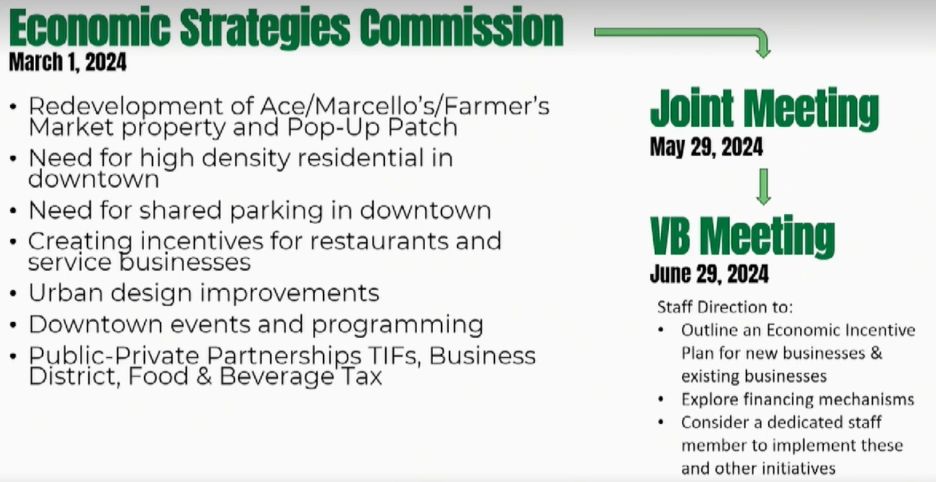
The narrative presented at the August 27, 2024 Board meeting – the same meeting where we first learned of the interest Hometown had in Northbrook – was that Village leadership was in the midst of a methodical process to build out its own modern incentive framework. That process began with recommendations submitted by the Economic Strategy Commission (ESC) on March 1, which were formally reviewed in a Joint Meeting with the Board on May 29. This led to a directive for staff, in the June 29 Board Meeting, to begin developing a comprehensive Economic Incentive Plan — including strategies for both new and existing businesses, an exploration of funding mechanisms, and a recommendation to add dedicated staff capacity, mirroring Glenview’s structure.
Then came Hometown.
As the Village President explained during the August 27 meeting:
“We anticipated as a Village Board having an incentive plan that would run through the process, staff would present things to us, everybody could apply at the same time — new businesses, current businesses, all sorts of stuff. Well, Hometown knocked at the door. Hometown is a proven, sought-after community asset in all the towns that it is in. It has made a significant difference in towns like Winnetka and Lake Forest where it has gone in some blighted areas and reinvented those areas.”
She went on to describe the proposed agreement — still subject to vetting — for Hometown to redevelop the former Katz Eye Center, described as a vacant and blighted property sitting at “the gateway of our downtown.” Hometown had identified a $1.5M economic gap for which they needed assistance, and staff worked with them to negotiate terms to help close it. The total project cost, including purchase, was estimated between $3–4M, with a little over $1.5M allocated specifically to improvements.
The agreement on the table would provide a loan of up to $1.5M — strictly for construction costs — at a 6% fixed interest rate, to be repaid over 15 years. Repayment is tied to the Village’s 2% share of sales tax generated by the business, which is applied to reduce the principal balance each year. Any remaining principal at the end of the term is due in a balloon payment. Interest is calculated and paid annually to the Village, on the anniversary of the loan disbursement, until the principal is fully paid off.
For example: Suppose the loan is disbursed on September 1, 2025. In a hypothetical first year, Hometown generates $50,000 in sales tax. That amount would reduce the principal to $1.45M. At 6%, the corresponding interest payment would be $87,000. In year two, if another $75,000 in sales tax comes in, the principal would fall to $1.375M, and the interest due that year would be $82,500. And so on until the sooner of Year 15 or a $0 balance. These are just illustrative figures, of course — we don’t yet know how the business will perform. But the mechanics are important to understand. In this scenario, the Village actually collects more in interest than it gives up in redirected sales tax – which seems likely for the first few years in most scenarios.
The deal also includes several built-in safeguards. No funds are disbursed until Hometown provides a fully executed lease, confirms the property is vacated, signs a formal Note in favor of the Village, and incurs eligible construction expenses. If construction costs come in below $1.5M, the loan amount is reduced proportionally. The business is required to open no later than December 31, 2025. The Village retains lien rights on all fixtures, furnishings, and equipment, along with “open book” access to monitor financials. Any future sale of the business or material changes to the lease must also receive Village approval — a protection designed to maintain continuity and alignment with the agreement’s original goals.
It is a well-constructed deal and by no means does it “gift” Hometown the money.
To better understand the financial mechanics of this deal, let’s run a few illustrative scenarios.
Note that I am making a few simplifying assumptions. While there will almost certainly be some lag between when the Village disburses the loan and when Hometown begins generating revenue, the following cases are modeled assuming no lag. Assumptions also include consistent hours of 7:00 a.m. to 5:00 p.m., year-round operation with no holiday closures, flat demand with no seasonal variation, and no food & beverage tax (which wouldn’t apply to loan repayment).
There are four scenarios modeled below:
- Base Case – Exactly $1.5M in sales tax revenue is generated — enough to repay the full loan via sales tax alone. Annual Interest Payments are made totaling $630K.
- Overperform – $1.5M is generated in twelve years to pay off the principal early. The site generates another $375K in the final three years. Interest totals $495K.
- Underperform – $640K in sales tax revenue is generated resulting in a $900K balloon payment after year fifteen. Interest totals $1.06M.
- Most Likely – $80K in annual sales tax totaling $1.2M. Balloon payment of $300K and total interest of $774K.

To put the base case in perspective, it would mean $5M in annual sales, just under $13,700 per day, or $1,370 per hour. If the average customer spends $10 per visit, that translates to 137 customers per hour — every hour — for fifteen years. Hometown claims to serve about 1M customers each year across its three locations currently.
Only time will tell what happens. The Village seems to expect that a $300K balloon payment at the end of the loan term. That estimate aligns on the high end of staff projections suggesting the business could generate between $60,000 and $80,000 in local sales tax annually. And it’s worth noting that in every scenario outlined, a vacant and dated property has been brought back to life.
I appreciate what the Board is trying to do here and fully support this kind of arrangement – when applied thoughtfully — as a tactic within a broader strategic framework to position our downtown as a more powerful economic engine for the community.
Why? Because it shifts the burden away from current residents and onto future growth. It builds accountability — if a business doesn’t perform, the Village still gets paid. And it signals that Northbrook is finally willing to compete. Compete with Glenview. With Highland Park. With other North Shore communities that are using public-private tools to shape their future, attract standout operators, and revitalize underused corridors.
This Hometown agreement has drawn understandable criticism in places, but the underlying structure is sound — and it reflects a level of financial creativity I wish the Board would apply in other areas, especially affordable housing.
So where did the money come from?
Unlike Glenview — which had the foresight (and good fortune) to sell off its former Naval Air Station and create a $20M Permanent Fund — Northbrook doesn’t have a standing pool of economic development dollars. But in this case, it appears the Village was working with more flexibility than usual.
While I couldn’t find a specific reference to the funding source in public documents, I believe the money came from stronger-than-expected General Fund performance. Northbrook finished the year with higher revenues than projected, exceeding the required 40% reserve threshold for annual expenses. When that happens, Village policy allows the use of surplus funds for one-time investments — like downtown redevelopment — but not for ongoing operations.
If that’s right — and assuming there weren’t other urgent capital needs competing for the dollars — this seems like a smart use of surplus. A positive-ROI investment, designed to attract a proven operator willing to bet on itself, and to activate a dormant stretch of Shermer.
But for this approach to succeed long-term, it can’t stop with one deal — and it certainly can’t depend on consistently exceeding the General Fund’s reserve threshold to fund new projects. What we need is a clear, accessible, and transparent incentive program: one that’s rigorous enough to maintain standards, but not so bureaucratic that it deters interest. A framework that welcomes both new and existing businesses and uses objective, clearly articulated criteria to evaluate proposals on their merits.
That’s the part I’m still less confident about.
You may recall the Village’s narrative from the August 27 meeting: a methodical, step-by-step process that began with the ESC’s March 1 recommendations, was formally reviewed on May 29, and culminated in a June 29 directive to begin designing an open and transparent incentive program. One slide (included above) even presented this as a deliberate and orderly timeline — a sign that the Village had it all under control. The implication was that the Hometown proposal happened to arrive just as that system was coming together, and staff simply shifted their efforts to make the deal work.
But that version of events doesn’t hold up under scrutiny.
For starters, the “March 1 recommendations” weren’t new. They were drafted by the Economic Strategy Commission in April 2023 and formally transmitted to the Board in June 2023. What the Board received in March 2024 was staff feedback on those recommendations — not a fresh set of ideas. And as I outlined in Part I, the ESC itself now appears defunct.
Second, there was no Village Board meeting on June 29, 2024, as the slide claims. June 29 was a Saturday. The Board did meet on June 11 and June 25, but I could not find any substantive discussion of an Economic Incentive Plan in either of those meetings — nor in the three that followed.
It’s possible the reference was meant to point to the May 29 Joint Meeting — though since that session wasn’t recorded, we’re left to rely entirely on the meeting minutes. Those minutes include only two brief mentions of economic incentives. One Village official noted that it's now common for restaurants to request incentives when exploring new locations. A commissioner responded by suggesting the Village should prioritize support for existing restaurants before offering incentives to new ones. The minutes also reference the need for further discussion on two restaurant-related proposals and include a directive for staff to clarify which incentives were proposed versus already in place. That’s the full extent of the record — and given how limited those references are, it’s hard to believe this was the meeting cited in the narrative.
If I had to guess, the intended reference was actually the June 25, 2024 Committee of the Whole meeting. That meeting’s most definitive directive was for staff to begin preparing the necessary paperwork to implement a 1% Food and Beverage Tax. The minutes for that meeting — which are marked as “amended,” though it’s unclear when or what was amended — do not document any explicit instruction to create a structured, transparent economic incentive program. It’s possible that portion of the discussion simply wasn’t captured in the minutes.
What is clear is that Village officials discussed the proposed tax as a funding mechanism for new economic development efforts, with an emphasis on revitalizing downtown Northbrook. The tax would apply to prepared food and beverages intended for immediate consumption, excluding groceries and packaged liquor. Proceeds would be used to seed a revitalization program — including support for business recruitment and retention, as well as the creation of a new staff position focused on economic development.
At the time, the ordinance codifying the tax was expected to appear before the Board of Trustees in August 2024, with hiring for the new staff role projected for late fall.
While the ordinance did not end up appearing on the August 27th agenda, word of it set off a firestorm. A Chicago Tribune article published the following week carried a misleading headline — “Popular Northbrook restaurant closes as Village officials mull new 1% food and beverage tax” — accompanied by a photo of the co-owner of Trattoria Oliverii, implying her restaurant was the one closing and that perhaps it was due to the proposed new tax. In reality, the restaurant referenced in the headline was Marcello’s, which had announced its closure separately and not due to the proposed tax.
Still, the article revealed a disconnect. During the meeting, Village officials clearly framed the tax as a way to fund downtown revitalization efforts and directly support local restaurants — including through new staffing and incentive programs. But the operators quoted in the article responded with frustration, framing it as just another cost burden. “It’s the 30 cents that would have gone in my pocket,” said one. Another called it “egregious”, adding, “Why do they keep putting it on the small businesses and businesses that have been here forever… instead of helping us out, they keep taking from us.” It’s unclear whether these business owners fully understood the Village’s intent and disagreed with it — or if they first learned of the proposal through the reporter’s inquiry and reacted based on that limited framing.
The Village President addressed this — sort of — at the August 27 meeting, referencing the ESC-to-incentive timeline slide. She expressed disappointment that, “instead of the message getting out... that the Village of Northbrook wants to fund a business incentive program... what got out in the media was that the Village was going to do a food & beverage tax.” She added that misinformation around the possible closure of a “treasured restaurant” forced the owners to post clarifications on social media. In her view, the 1% tax was designed to support, not burden, local restaurants — and to fund future incentives that could help them grow.
The Village later indicated — as part of a broader FAQ shortly after the November meeting — that “Over the next 3–4 months, Village staff will work closely with the Economic Strategy Commission and stakeholders to create a pilot program that aligns with Northbrook’s unique needs and supports both new and existing businesses. As we progress, we will share updates and program details with the business community and the public, ensuring everyone has the opportunity to participate and benefit from this initiative.”
This is the most frustrating part of the whole ordeal for me. Although the Village clearly referenced next steps in that FAQ (that still sit on the Village website to the day this was published), no documentation has surfaced. If those meetings occurred, they haven’t been made public. We’re now more than five months past the approval vote with no clear updates or framework in sight.
In the end, no Food & Beverage tax was enacted in 2025, no role focused entirely on economic development has been budgeted, no pilot program has been launched, and no process for granting business incentives has been shared publicly. What we do have is the incentive approved for Hometown and streetscape work on Shermer.
And that brings us back to the Village’s narrative. The story presented — that Northbrook was steadily building a thoughtful, methodical incentive framework and simply pivoted when Hometown came knocking — simply doesn’t hold up under closer inspection. Viewed alongside the full ESC timeline and the lack of visible progress in the five months since the deal was approved, it’s hard to see this as anything but a one-off decision. If there was a plan in motion, it was never formalized. The system still hasn’t taken shape.
Against that backdrop — and the broader themes I’ve explored in this space — it’s not surprising that this deal has been controversial for many residents.
Much of the frustration is because of the impact on the competitive balance in the downtown.
Leonidas and Georgie V’s aren’t identical to Hometown, but they serve overlapping customer bases and time slots — breakfast, lunch, mid-day meetings. While Hometown will clearly generate some net new sales tax revenue, some portion will almost certainly come at the expense of current businesses. And that shifts the frame: how much the revitalization is actually growing the pie — or just slicing it differently. If either — or worse, both — of these long-standing businesses were to close as a result, that doesn’t feel like a win for Northbrook.
Complicating matters is the arrival of Bean Bar, which opened last week just steps from where Hometown is slated to launch — and with a concept that, on paper, looks strikingly similar. Operated by the Eataco team, Bean Bar describes itself as a “modern social coffee bar” offering private rooms for studying, meetings, and events. Hometown positions itself as a warm, community-first café, designed to bring people together across ages and backgrounds. Both emphasize versatility, connection, and gathering space — and both are courting the same core customers: families, professionals, and students. That overlap raises reasonable questions about market saturation, timing, and the optics of publicly backing one venture while the other — a locally grown concept — was already investing privately, without Village support.
Bean Bar was already poised to challenge Georgie V’s and Leonidas to some degree — though it’s also fair to say that both Bean Bar and Hometown are addressing a gap Northbrook has long had: a modern café that doubles as a true community gathering space.
Bean Bar’s owners began the process of renovating the former Chase Bank site in December 2023. When news of the potential Hometown deal broke in August, they were knee deep in Northbrook's infamous permitting process. It had to feel like a slap in the face when, as they struggled to circumnavigate the widely felt frustration of developing in Northbrook, the Village appeared to roll out the red carpet to an “outsider” who would directly compete with them. Their social media posts at the time clearly reflect that – indicating they had been waiting for permits for “months” and could not get responses to emails for even the most basic requests. They also likely did not understand the full terms of what the Village was contemplating – calling it a hand-out, which it is not.
I give them credit though – they clearly think they can thrive, despite this unexpected competition. In August, they spoke out at the Board meeting against the deal though the direction seemed clear. Their bigger challenge may not be the competition, but the uncertainty surrounding their location. As discussed in Part I, the Heitman property (which includes their storefront) has been on the market for years, with signs pointing to a sale in the works. During the August meeting, the Village President called it the commercial equivalent of a residential teardown, noting that the owner was no longer offering long-term leases — perhaps trying to send a less than subtle message to Bean Bar’s owners, who were sitting in the front row.
Still, the Bean Bar team pressed ahead. The announcement of their soft launch on April 18 drew enthusiasm: over 330 reactions, 70 comments, and 13 shares on Facebook. Anecdotally, foot traffic was strong in those first days, and early reviews have been glowing. My family has already made three visits — the coffee, Strawberry Matcha, Chicken Pesto sandwiches, and Ahi Tuna salad all earned high marks. The redesigned space is warm & welcoming, and there is real potential for the business to thrive.
This isn’t a fluke based on what the owners have demonstrated with Eataco. Since we moved to Northbrook, 1350 Shermer has cycled through numerous businesses with interspersed periods of extended vacancy. Eataco opened there in 2019 and not only survived COVID (evidently without financial assistance)—it thrived, expanding next door with the launch of The Next Door Lounge. One of the co-owners is a GBN grad, and there’s a genuine groundswell of community support behind what they’ve built. In many ways, the brouhaha around Hometown may have been some of the best viral marketing they could have asked for. Now, they need to execute and deliver a superior product and experience.
On the other side, Hometown’s owners have been aware of Bean Bar’s plans since at least August – when their representatives heard Bean Bar’s impassioned pleas not to approve the deal – yet they’re pressing forward with what will be their fifth — and, I believe, second-largest — location at 4,500 square feet. If the site underperforms, they’ll be holding a fully renovated space with a hefty loan to repay. Though we have not seen shovels in the dirt yet, they seem confident. Their parallel project in Glenview and a new partnership with Dinx Social Club in Highland Park suggest an ambitious growth strategy. This is a calculated risk, and they’re betting that their concept — and their ability to scale it — will stand out.
There’s little doubt that Northbrook isn’t likely to support both new entrants on top of what’s already here. Although we’ve made many trips to Hometown in Glencoe, I’m obviously rooting for Bean Bar — especially if only one survives.
But if we want to rev the downtown economic engine — and believe that performance-based incentives are a sound tool (and I do) — then the Village’s role needs to be defined and disciplined. It’s fine to pick winners. That’s what incentives do. But how we do it matters. The process should be rooted in objective, transparent criteria: financial viability, meaningful investment, alignment with revitalization goals. What it shouldn’t involve is Village staff or Trustees trying to assess the competitive balance of downtown, forecast consumer preferences, or determine which concepts are most deserving based on perceived fit. That’s a slippery slope — and one that undermines the clarity and fairness a public incentive program requires.
Set the standards. Make them public. Apply them consistently. And let the businesses with the best product and experience — as judged by customers — rise to the top.
Take 1290 Shermer as a case in point. The Village doesn’t own the property and can’t control what kind of business goes there. If we want them to have that control, we should encourage them to buy the land and act as a master planner — but let’s remember how that’s gone so far with the Grainger site.
Given how hyper-critical many of us have been of this Board, it’s more than a little ironic to suggest they add more complexity to their process or become harder to work with. This is the same Board that’s taken sustained criticism for inaction — especially on Green Acres, Grainger, and Northbrook Court — and for a general lack of urgency around zoning and facilities. So when a viable opportunity finally landed, it’s hard to fault them for moving quickly. Hometown brought a site-specific proposal, committed real capital, and took on risk. Nothing stopped Bean Bar — or any other operator — from doing the same.
That doesn’t mean the process was flawless. It wasn’t. There are legitimate critiques — the sidelining of the ESC, the confusing public narrative, the optics of one business struggling while another gets a green light. And most of all, the absence of the broader strategy we were told was coming. After the tone of this last election — and the promises made during it — we can’t afford more erosion of public trust. Communities lose faith not just when leaders get the policy wrong, but when they don’t follow through on what they said they’d do.
We’re now more than two years removed from the formation of the Economic Strategy Commission — a group of highly capable volunteers brought in to help modernize the Village’s approach. If progress has been made, the evidence is hard to find. I hope I’m wrong — that I’ve simply grown too cynical from hearing more hope than candor. Maybe real work is happening behind the scenes. But if I’m not, it’s worth asking: would we have ended up in this same place — this deal, this debate — even without all that effort? And if so, what does that say about how we’ve followed through on the goals we set and the narrative we built around them?
I’m rooting for Bean Bar to thrive. I’m partial to Georgie V’s and Leonidas too — and hopeful that all of them find success. It would be best if Hometown also does well. Because in the end, I’m on Team Northbrook.
But faith in institutions doesn’t come from words or intentions. It comes from what happens next — and whether this Board is willing to build a system that delivers on the promises it made.